
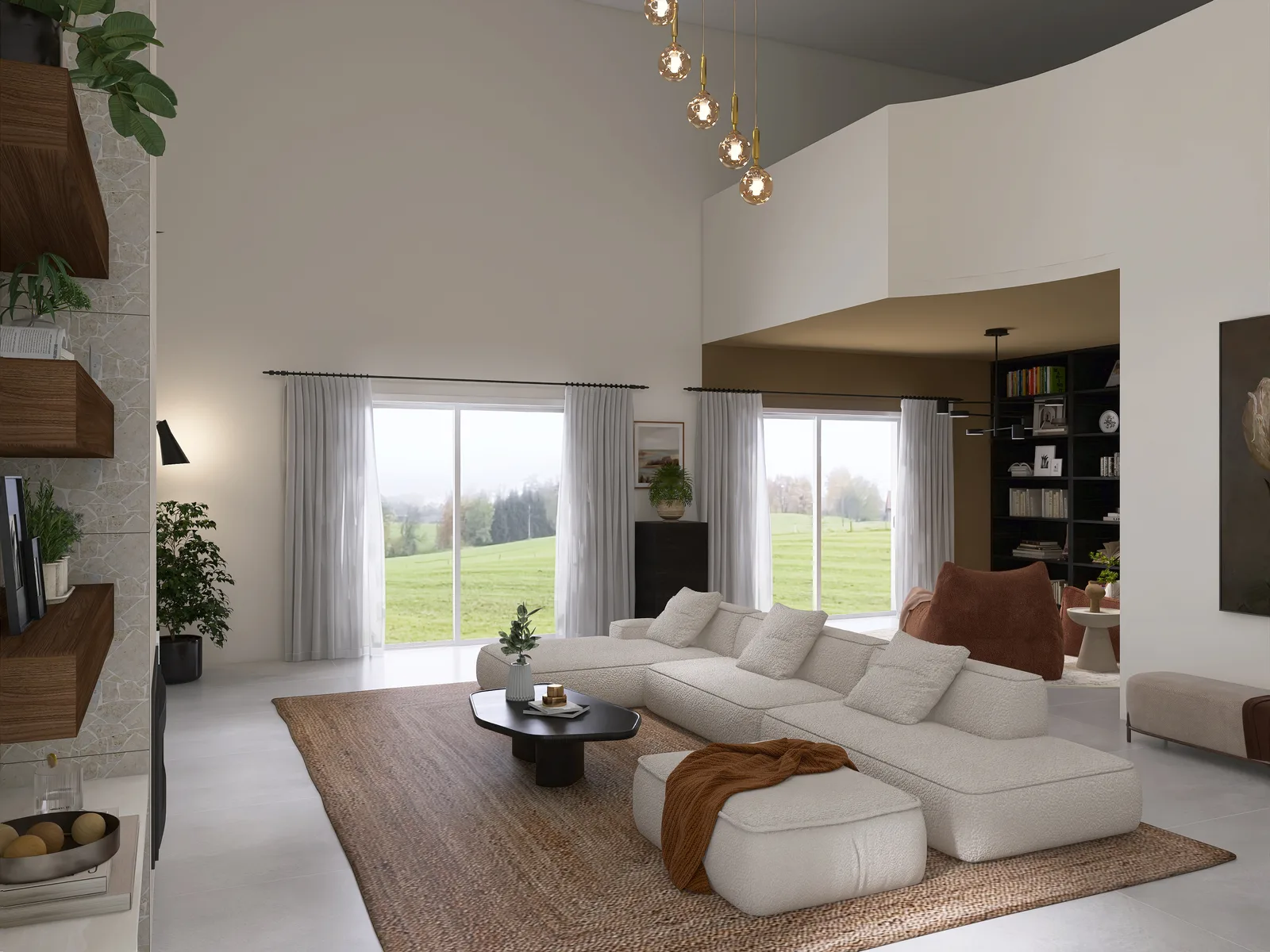
The situation nearly always has the same shape. A family owns a house in Portugal, inherited, bought last spring, or half-built by a contractor now at the top of the walls. The purchase went fine. The licence went fine. Then somebody has to choose forty things at once, from another country, in a language they may not read, with three weeks of holiday to do it.
That gap is real. Relocation blogs, property portals and municipal websites cover buying, taxes and permits in detail. Almost nobody writes about the phase that decides whether a house feels finished: floors, kitchens, bathrooms, built-ins, lighting, curtains, furniture, and the order in which the trades who install them are let on site. This is that missing chapter.
Why remote projects go wrong at the finishing stage
Building a house in Portugal from abroad rarely fails on the big decisions. It fails on the small, non-returnable ones, and it fails in three predictable ways.
Finishes chosen from a screen. A tile that looked warm grey in a supplier’s photograph turns lilac in the Portuguese afternoon; a stone that looked calm in a 12 cm sample runs dramatic across a three-metre island. Screens flatten colour, scale and reflectivity, the three things that make a finish work in a room.
Trades in the wrong order. The tiler arrives before the electrician has set socket heights; the painter finishes before the carpenter takes final measurements; the floor goes down before the kitchen is templated. Each of these costs money to undo, and the undoing happens while you are far away.
Deliveries nobody receives. Custom joinery arrives at a locked gate; a sofa is signed for by a neighbour without anyone checking the fabric. Damage found three months later is damage you pay for.
None of this is Portuguese; it is a distance problem, and Portugal has plenty of it. Around 1.8 million Portuguese nationals lived abroad in 2024, close to 1.29 million of them in Europe, on the UN estimates compiled by the Observatório da Emigração. The United Kingdom, France and Germany are in turn among the largest foreign-national resident groups in Portugal, many of them owning a house here long before moving into it.
What you can decide over video, and what needs a visit
The most useful thing you can do at the start is sort every decision into two buckets. Not by importance: by whether the answer changes when you stand in the room.
| Decide over video | Needs a room and daylight |
|---|---|
| Brief, budget bands, priorities | Site measurements and level checks |
| Floor plans and circulation | Stone slabs, veneers, large-format tile |
| Lighting plan and switch logic | Final paint and plaster colour |
| Furniture list and supplier shortlists | Joinery mock-ups and handle heights |
| Textiles, rugs, loose pieces from samples | Bathroom layouts against real walls |
The rule behind the table: anything you cannot return gets a physical check, by you, or by your designer on your behalf. Anything exchangeable can be approved from a photograph and a sample in the post.
Light is the reason the right-hand column exists. Central Portugal has a warm-summer Mediterranean climate: long-term summaries put Coimbra at roughly 866 mm of rain a year with a bone-dry July and August, and the coast at Figueira da Foz nearer 600 mm; the official normals can be looked up at IPMA. The light is brighter and more reflected than in Manchester, Zurich or Düsseldorf: greys go blue, warm whites go yellow, oak reads a shade redder. Test the palette on the actual wall.
Build a decision calendar around your trips
Owners abroad do not have a schedule; they have flights. School terms and August shutdowns mean most families are physically in Portugal two or three times a year. Design the project around that rather than against it.
- Work backwards from the night you want to sleep in the house. That date sets everything else.
- List the long-lead items first, kitchen, bathrooms, windows and exterior doors, built-in wardrobes, upholstered sofas and beds. These are made, not bought, and they set the critical path.
- Bundle every site-dependent decision into a visit. One well-prepared week with samples laid out on the floor replaces four months of email.
- Fix a weekly reporting slot with your designer or project manager, so nothing waits for your next flight to be approved.
- Keep the styling day for the end, timed to your arrival, the difference between a finished house and a furnished one.
The two halves map onto how we work. Our online interior design service carries the concept phase (brief, layout, lighting, palette, furniture list) entirely over video. Full-service interior design adds the on-site phases: measuring, site supervision, coordination of trades and suppliers, custom joinery and the styling day.
Portuguese trades, joinery and lead times
Two things surprise most foreign owners. The first is how much can be made rather than bought here: Portugal has a deep furniture and joinery industry, and Paços de Ferreira near Porto (the country’s “Capital do Móvel”) has hundreds of furniture makers within a few kilometres of each other. Custom wardrobes, a bespoke island, a window bench with drawers, all realistic here, and usually the more practical route than importing.
The second is that this industry runs on its own calendar. Workshops are small, they take work in the order it is confirmed, and August is genuinely slower. Lead times run in weeks to months, and they start when measurements are signed off, not when you first ask. Joinery in place for a Christmas arrival is templated in summer.
Who does what on a Portuguese site
Roles on a licensed build are legally distinct: the author of the project, the contractor’s site manager (diretor de obra) and the owner’s supervising technician (diretor de fiscalização). An interior designer works alongside them (specifying finishes, joinery, lighting and furniture, ordering, chasing and inspecting what arrives) but does not replace those licensed technicians. Worth knowing before you assume one person covers everything.
Permissions follow the same logic of proportion. New construction and extensions need a licence or a prior notification depending on the plan context, while conservation works and interior alterations that do not touch structure, façade, roof or height are generally exempt; the process was simplified in 2024. The specifics belong to your Câmara Municipal, and one call there before you order anything is time well spent.
Buying furniture abroad and shipping it in
Owners in the UK, Switzerland or the United States often ask whether to bring their own furniture. You can. But goods entering the EU from outside it may attract customs formalities and VAT, delivery windows are hard to align with the trades on site, and damage is far harder to resolve across a border. Buying within Portugal or the EU keeps the supplier within reach of whoever supervises your project. Check your own case with a customs adviser first.
How approvals work when you are not there
Reporting is not an extra on a remote project; it is the project. After each site visit we send a milestone report, and a good one answers four questions:
- What was done since the last report, photographs and a short video walk-through, not a status line.
- What happens next, and which trade is on site for it.
- What needs your decision, and by when, with the cost of missing that date spelled out.
- Any deviation from the plan, with the reason and the options.
Approve in writing, and keep one shared decision log. The point is not bureaucracy; it is that the tiler and the carpenter read the same answer to the same question. Most expensive misunderstandings on a remote site come from a decision that lived only in a phone call.
A worked scenario: finishing a moradia near Pombal or Leiria
A common shape of project in Central Portugal. A family in the UK owns a nearly finished moradia off the A1 corridor. The builder is delivering shell, roof and services. They have three weeks in August and want to move in the following spring.
Phase 1, online (autumn). Brief, room-by-room layout, lighting and switch plan, material palette, furniture list, supplier shortlists, budget bands. Nobody flies anywhere.
Phase 2, on site (their winter visit). Measuring, samples in real daylight, stone chosen from the slab, joinery drawings signed off, bathroom layouts confirmed against the built walls.
Phase 3, remote (spring). Ordering, chasing, sequencing trades around the joinery dates, checking deliveries, weekly reports.
Phase 4, styling day (their arrival). Curtains hung, beds made, art placed. They walk into a house, not a building site.
The geography helps. Pombal (51,170 residents at the 2021 census) sits on the A1, A17 and IC8 with rail on the Linha do Norte, putting trades and suppliers from both Coimbra and Leiria within the same day. Leiria (128,640 residents) is the region’s industrial centre, with the plastics and moulds cluster around Marinha Grande and real depth of fabrication skill. Coimbra adds the supplier depth and specialist labour of a university city. From our Lisbon studio all three are a straightforward drive up the A1.
If the house is by the sea
Coastal houses change the brief. In Figueira da Foz, Buarcos and along the Silver Coast, salt air and winter humidity go after metals, veneers and textiles long before anything looks worn, we set out the specifications that hold up in our guide to coastal home materials and salt air. If the house stands empty for months, ventilation and dehumidification are design decisions to take early, not appliances bought in a panic in year two.
Frequently asked questions
Can I really finish a house in Portugal without being there?
Yes, if the concept is fixed early, non-returnable choices are checked in person by you or your designer, and one person on the ground orders, receives and reports. Video works well for layouts, plans and loose furniture; stone, custom joinery and colour need a physical check in Portuguese daylight.
Do I need a licence to renovate a house in Portugal?
It depends on the works. Under Portugal’s building regime new construction and extensions require a licence or a prior notification, while conservation works and interior changes that do not touch structure, façade or roof are generally exempt. The rules were simplified in 2024, so always confirm your specific case with your Câmara Municipal before starting.
How long does custom joinery or furniture take in Portugal?
Custom joinery and upholstered pieces are made to order and follow workshop calendars, including a slower August. Plan long-lead items first and order them as soon as the measurements on site are confirmed.
Can I ship furniture from the UK, Switzerland or the US to Portugal?
You can, but goods entering the EU from outside it may face customs formalities and VAT, and delivery windows are hard to align with the trades on site. Buying within Portugal or the EU is usually simpler; check your own case with a customs adviser.
What does an interior designer do that a builder does not?
A builder delivers the shell and the services. A designer plans layouts, lighting, materials, custom joinery and furniture, orders and chases suppliers, sequences the trades around them, checks deliveries and reports to you with photos and video.
How does Daradiant work with owners who live abroad?
The concept phase runs over video. On-site phases cover measuring, site supervision and a final styling day, with photo and video updates in between, and we coordinate trades and suppliers in Portuguese. It starts with a €99 Design Call or a free, phased proposal, and we reply to project requests within 24 hours.
How to start from abroad
Send four things and we can already tell you something useful: the plans, current photographs, a slow video walk-through room by room, and the dates you will next be in Portugal. Add a budget band, it shapes the advice more than any style preference.
From there, two routes. Book a €99 Design Call for an hour of honest advice on scope and sequence, or send your project through the contact form for a free, phased proposal, we reply within 24 hours. We work in Portuguese, English and German from our studio in Lisbon; see the finished work in our projects.
A house that gets built from a distance is not a compromise. It just needs the decisions taken in the right order, with somebody standing in the room when they are.