← Daradiant Interiors

English-Speaking Studio · Aachen & the Euregio

Interior designer in Aachen for researchers, engineers and cross-border families

You took the post at RWTH or the Uniklinik, left the furnished flat near Melaten, and now own four tall rooms in the Frankenberger Viertel, or a house in Laurensberg, close enough to walk over the Dutch border into Vaals. Daradiant plans and furnishes it with you in English, and talks to your German trades in German.

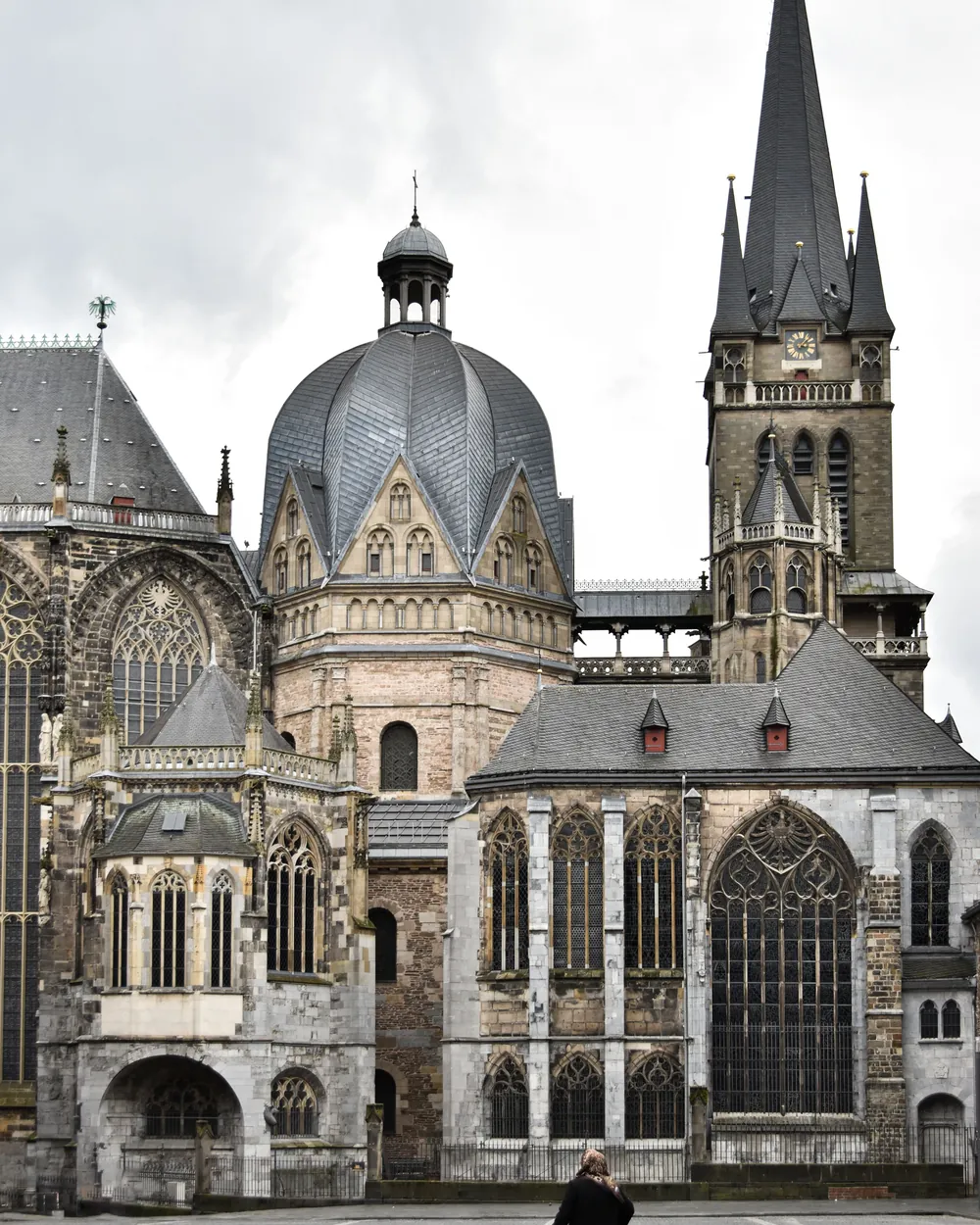
Aachen Cathedral with its octagonal dome and Gothic choir spire above the cobbled square in the old town

Designing for Germany’s most international city

An English-speaking studio for an English-speaking Aachen

RWTH Aachen has around 44,000 students, some 11,300 of them international, from 141 countries, plus more than 1,800 international staff, and the FH Aachen adds a second campus population on top of that. Around 9,000 people work at the Uniklinik on Pauwelsstraße, and the research campuses of Melaten and Campus West are still filling out. Add Forschungszentrum Jülich next door and you get a city where a remarkable share of households arrived from somewhere else, on a contract with an end date, and had to find a home fast.

Local design firms here are excellent and almost entirely German-speaking. Directories do not tell you which of them will send you a concept in English, and we have yet to find a page that explains, in English, what a Denkmalbereich actually permits behind your own front door. That gap is where we work: Dania Lima, founder of Daradiant, works fluently in English, German and Portuguese, so your side of the project runs in English while quotes, site meetings and orders run in German.

  • Full concepts for listed Altbau flats in the Frankenberger Viertel, Burtscheid and the Rehmviertel
  • Family houses in Laurensberg, Vaalserquartier, Steppenberg, Brand and Richterich
  • Layouts and storage for the small post-war flats of the rebuilt Altstadt
  • Home offices and quiet rooms for academic and clinical schedules
  • Remote-first e-design when you are renting and would rather buy well than build

Aachen housing, honestly read

Four kinds of home, four different conversations

The medieval core was largely destroyed in the war and rebuilt in the 1950s and 60s, so Aachen’s most desirable historic stock sits in the Gründerzeit belt just outside the Alleenring. What you bought decides almost everything about how we work.

01

Listed Altbau, 3.75 m ceilings

The Frankenberger Viertel was built between roughly 1870 and 1920 around Burg Frankenberg and holds over 250 listed monuments; Oppenhoffallee and Viktoriaallee are its show streets. Burtscheid, the former spa town incorporated in 1897, adds Jugendstil villas around the Kurpark. Stucco, tall windows, long room sequences, and a hallway that swallows a third of the floor area until it is fitted out properly.

02

Houses near campus and the border

Laurensberg, with Vaalserquartier and Steppenberg, puts detached and terraced houses within cycling distance of the Uniklinik and Campus Melaten and walking distance of Vaals. Brand, Eilendorf, Haaren, Kornelimünster and Richterich offer 1960s–2000s houses at lower entry prices. The recurring brief: open the closed kitchen, build a rain-proof entrance for bikes and boots, turn the basement into a real office.

03

Small flats in the rebuilt centre

Around the Markt, Ponttor and the Alleenring, post-war reconstruction flats and converted upper floors above shops carry the highest prices per square metre in the city on the smallest footprints. Here layout, built-in storage and a workspace that disappears at six decide whether the flat feels generous or cramped, not the furniture budget.

04

Homes across three borders

Vaals is 6 km from the centre, Kelmis about 8, Eupen and Heerlen around 20. Plenty of Aachen households live in a Dutch terraced house or a Belgian family home and work on this side. We design them the same way; we simply plan around different suppliers, different lead times and a delivery address in another country.

Light, damp and the December problem

Designing for long grey winters

Aachen sits at 173 m on the northern foot of the Eifel in an oceanic climate: 805–861 mm of rain a year, above the German average and spread across every month, with roughly three hours of sun a day in December against eleven in June. A flat that photographed beautifully in the June listing can feel like a different apartment in November. Most of that is fixable, and almost none of it is fixable with more ceiling spotlights.

Warm colour, not cool white

Ochre, terracotta, muted greens and warm greys hold their character under overcast skies; the cool whites that look crisp in a showroom turn blue by three in the afternoon.

Four heights of light

One pendant cannot fill a 3.75 m north-facing room. Ceiling, wall-washing, task and accent light at 2700–3000 K, all dimmable, plus sheer curtains at full height and pale oiled oak underfoot.

A small centre flat, before its first December

Most newcomers land in a compact rebuilt-centre flat in autumn. Work outwards from where the daylight actually falls: desk at the window, seating turned side-on to it, a mirror facing the glass, and lamps at three heights so the room still works at four in the afternoon.

Joinery that respects the walls

Where external insulation is not permitted, interior insulation and built-ins have to be drawn together, so no wardrobe ever ends up sealed against a cold outer wall.

Our completed reference in NRW

Kids’ rooms and homes that grow with the family

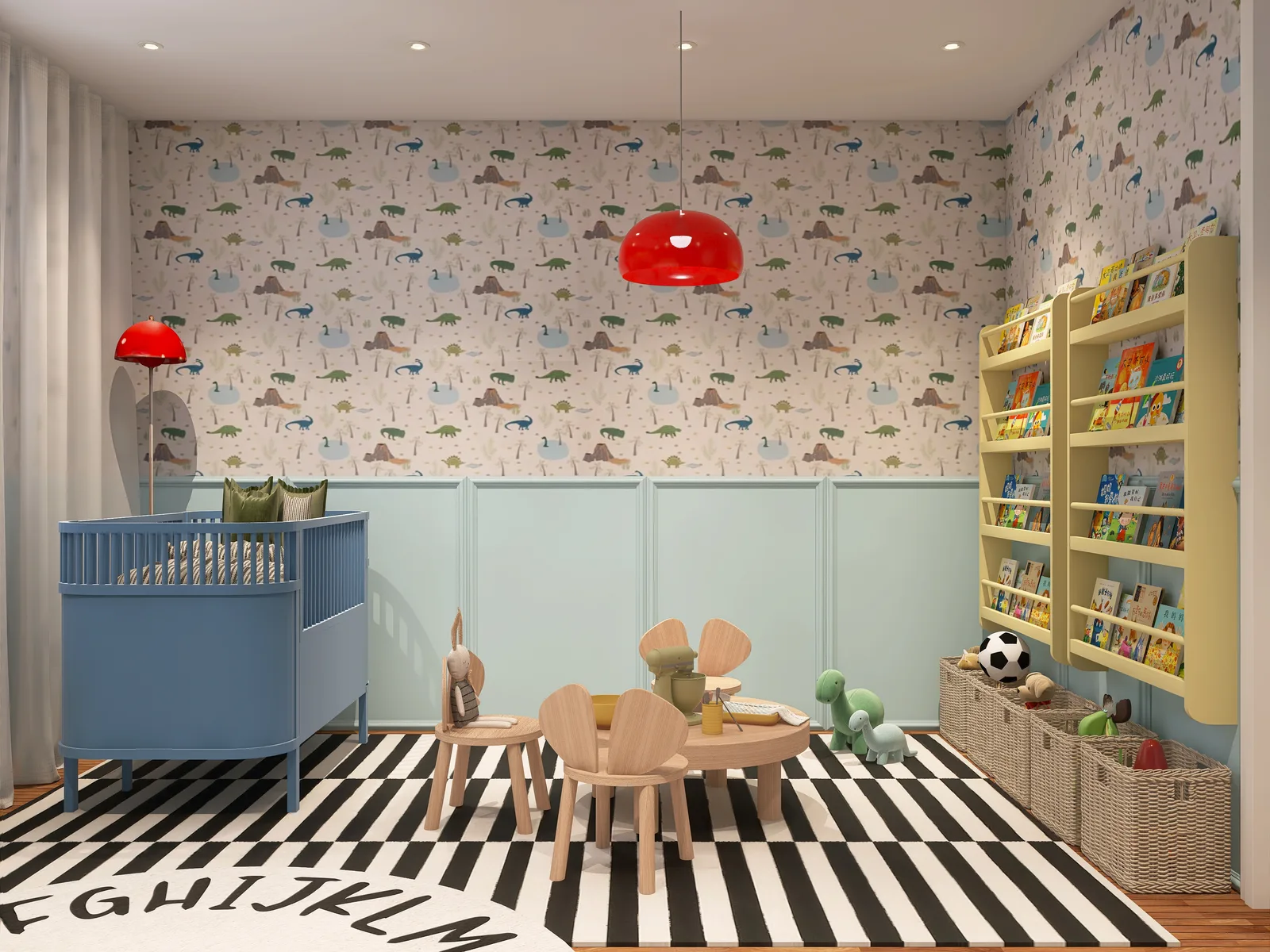
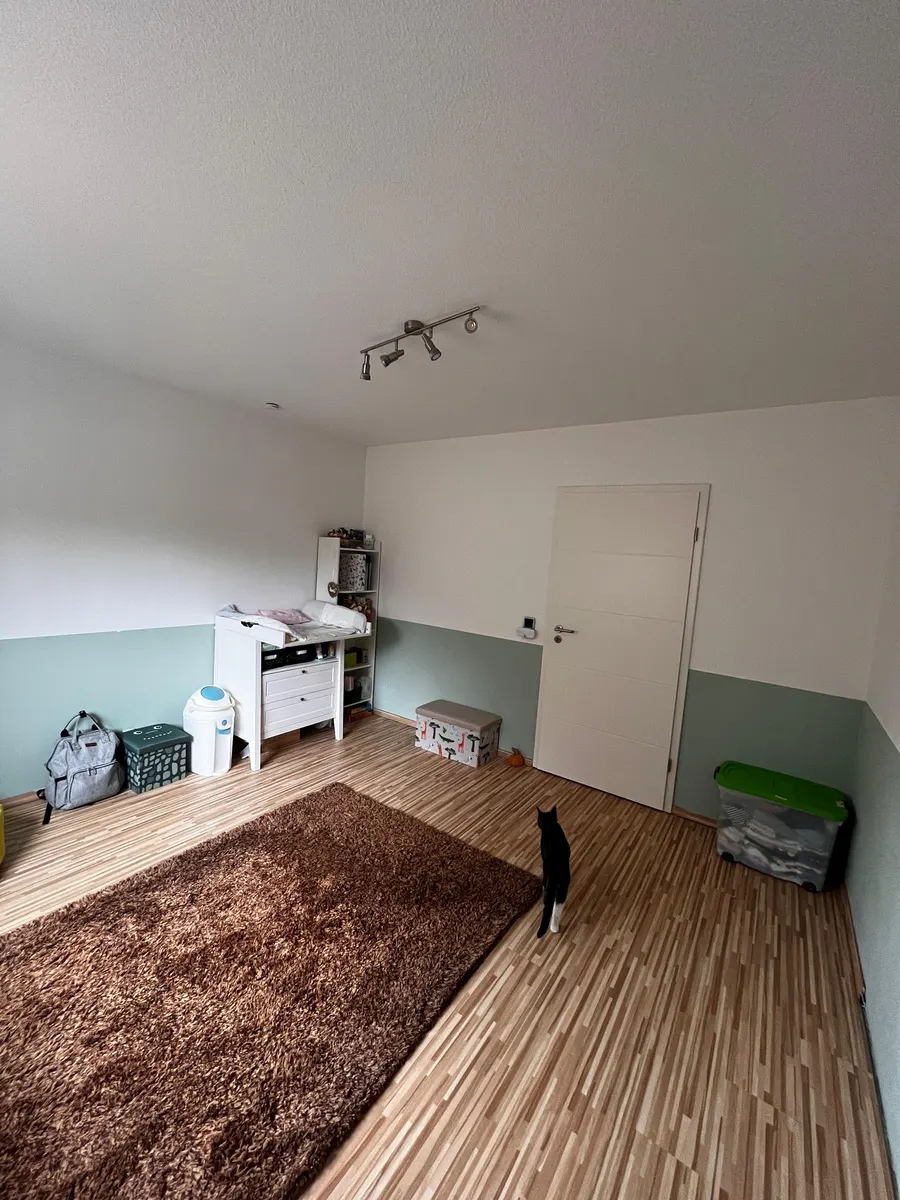
We have not yet completed a project in Aachen. Our finished German reference is The JJ Project in Heinsberg, north of here in Kreis Heinsberg: a nearly empty room turned into a whole child’s world, powder-blue crib and wardrobe, a pale-yellow changing dresser, mint wainscot panelling, dinosaur wallpaper, book racks at child height and a play table. The before photographs are real, and they are on the page.

The same method scales up rather than sideways in an Aachen Altbau. A nursery with 3.75 m ceilings has enormous unused volume: vertical storage to the picture rail, a proper reading light instead of one bright ceiling fixture, and soft surfaces to take the echo out of a tall room with hard floors. If cost is the obstacle, our Design for Everyone programme covers pro-bono Radiant Hearts projects and reduced-rate packages, conditions on request.

Children’s room with mint wainscot panelling, dinosaur wallpaper, a powder-blue crib, pale-yellow child-height book racks and a wooden play table on a black-and-white striped rug
The JJ Project, Heinsberg (NRW), the finished play corner with mint panelling and child-height book racks.
The same children’s room before the project: white walls above a sage-green dado, laminate flooring, a white changing table, a shelf unit and stacked storage boxes
The same room in Heinsberg before we started: white walls over a sage-green dado, laminate floor, a changing table and storage boxes.
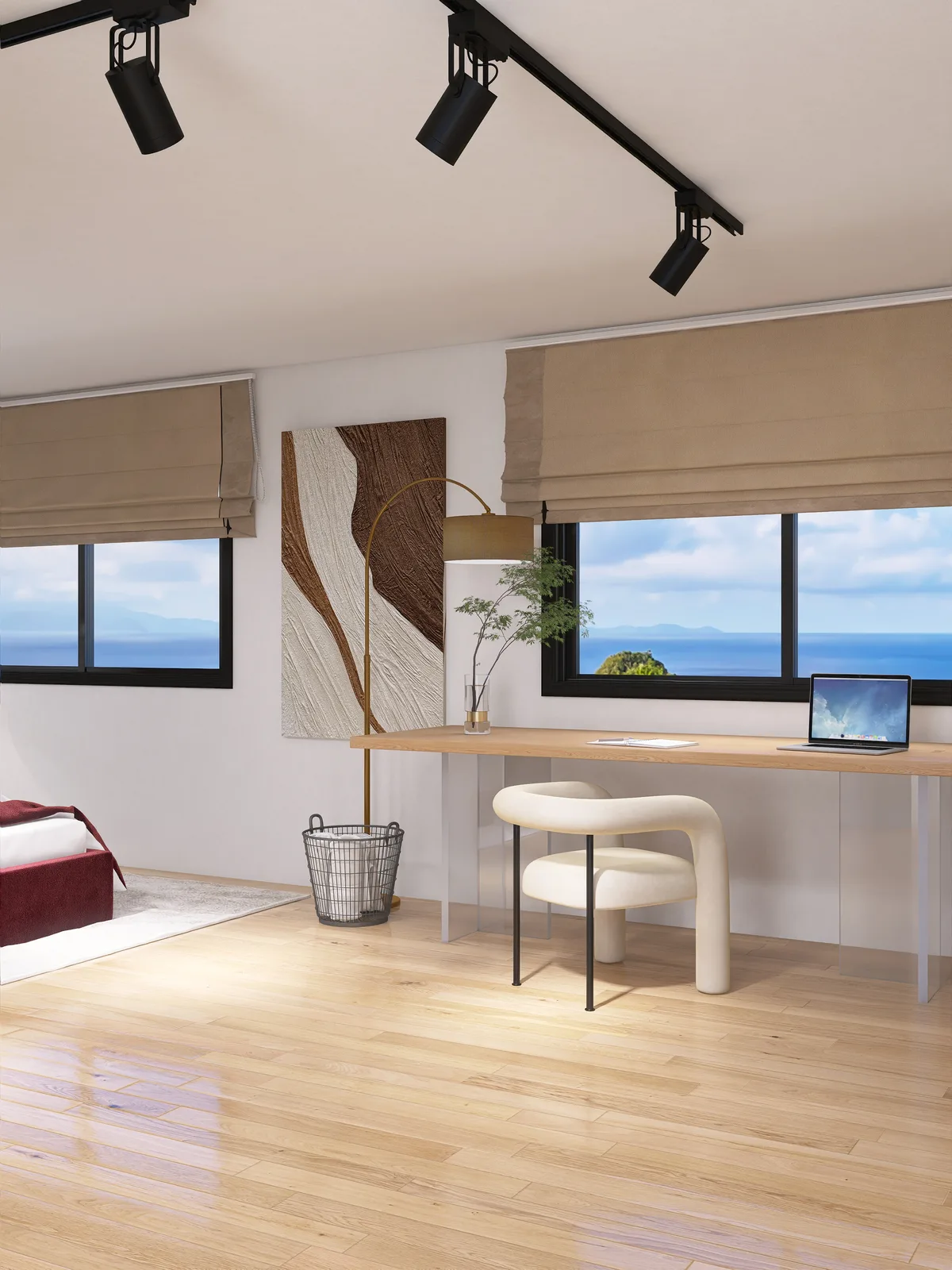
Home-office corner with a long oak desk top on slim supports in front of two windows with a distant sea view, an arc floor lamp and a rounded cream armchair
A long oak desk run along the window wall, the kind of workspace an academic household needs every day.
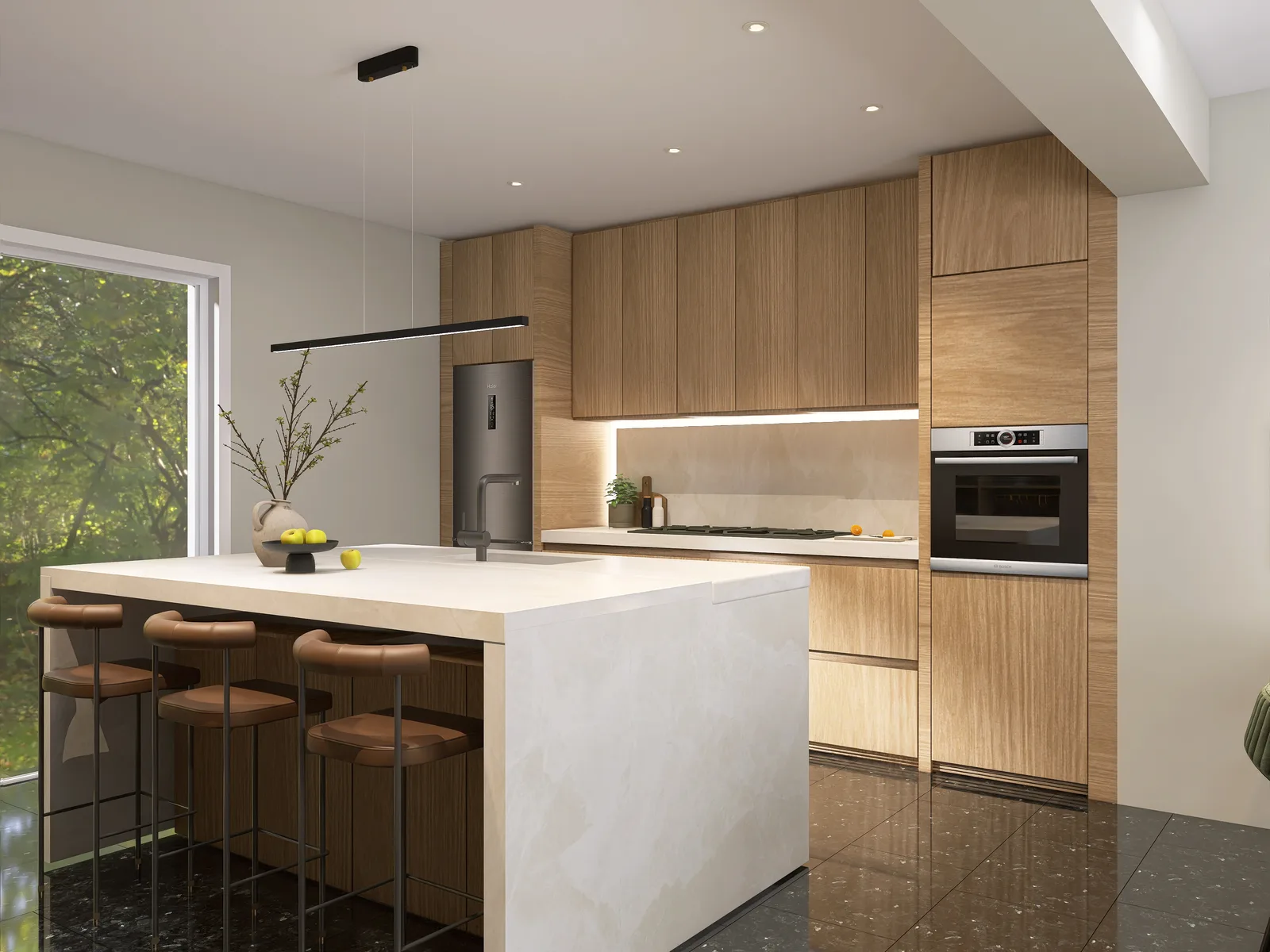
Open-plan kitchen with light oak cabinetry, a white stone waterfall island and a backlit stone splashback
Light oak, a stone waterfall island and a backlit splashback, an answer to the closed 1970s kitchen.

What Lisbon-based means for you

How a Lisbon studio runs a project in Aachen

Daradiant is based in Lisbon. There is no Aachen office, no showroom on the Alleenring and no local team, and if you are reading this from Vaals while working in Aachen and paying tax in two systems, you already know that a postal address is not what makes a collaboration work.

Here is the actual shape of it. The concept phase (briefing, floor plans, moodboards, materials, lighting) runs over video, the way most of your working life already does. The phases that genuinely need someone standing in the room are on site in NRW: measuring, site supervision at the milestones and the final styling day, planned per project as bundled trips and agreed in the proposal before anything is ordered. In between you get photo and video updates in English, while joiners, electricians and suppliers are briefed in German.

The upside is a two-country perspective. Portuguese colour and light instincts meet German planning discipline, custom joinery drawn in Lisbon is built by workshops here, and a household with a flat in Aachen and a house back home keeps one designer for both, including projects in Lisbon itself. Start with a design consultation, a full-service project, remote e-design, or a commercial space, a practice, an office or a small hotel.

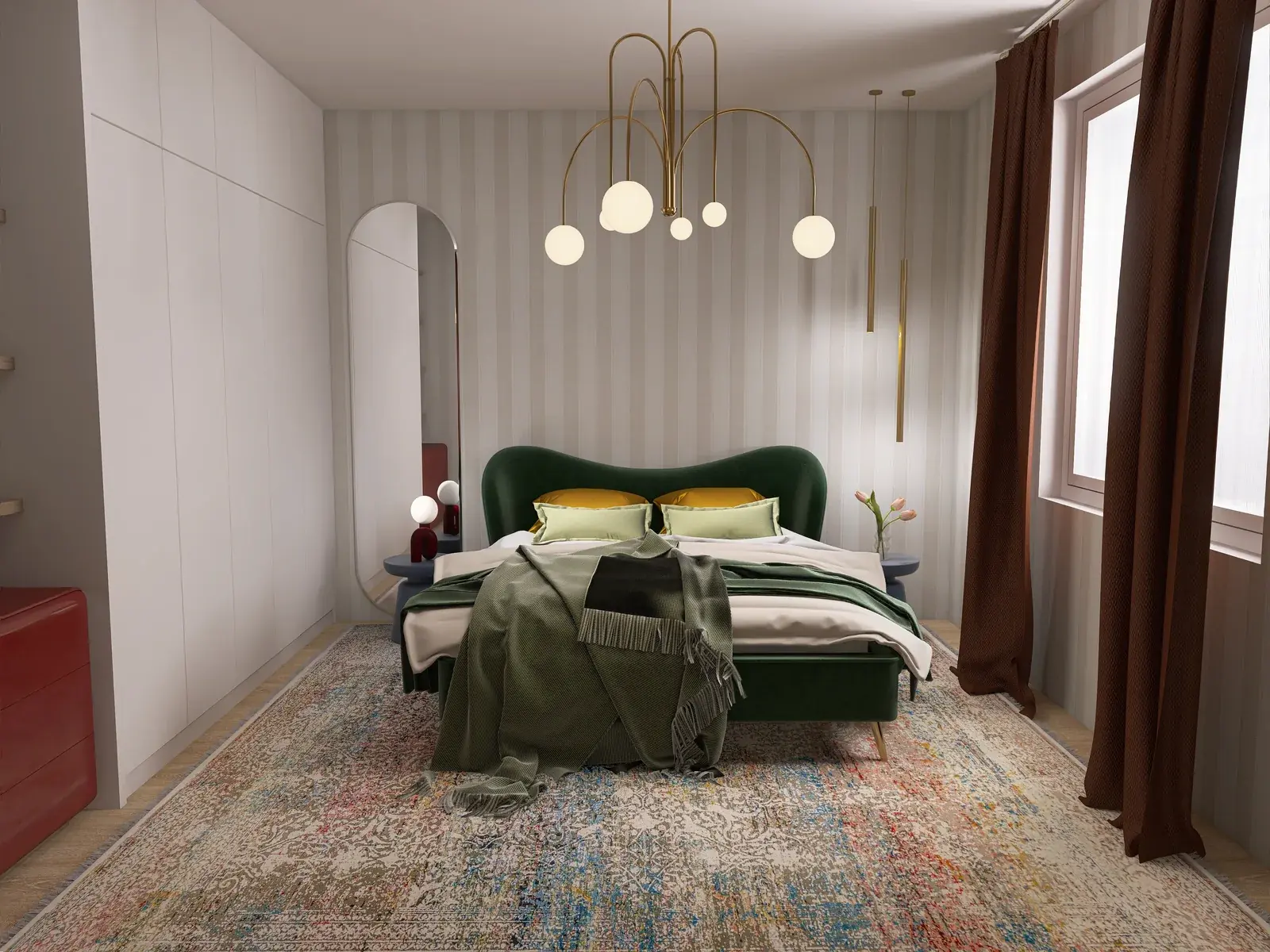
Room of Wonders, Lisboa, bedroom with an emerald green velvet bed with a curved headboard, a brass multi-arm chandelier, striped wallpaper and terracotta curtains: the colour and warmth we bring north

Frequently asked questions

Working with an interior designer in Aachen

Do you work in English in Aachen?

Yes. Founder Dania Lima works fluently in English, German and Portuguese. Everything on your side of the project happens in English (briefing, moodboards, plans, budgets, updates) while quotes, site meetings and orders with joiners, electricians and suppliers are handled in German. You never have to decode a Handwerker quote or explain a finish twice.

Where is Daradiant based, and how does that work for Aachen?

The studio is in Lisbon; there is no office on the Alleenring and no showroom here. The concept phase runs over video, and the phases that genuinely need a person in the room (measuring, site supervision at the milestones, the final styling day) are planned per project as bundled trips to NRW, agreed with you in the proposal before anything starts.

Can you help with a listed Altbau apartment in the Frankenberger Viertel?

Yes, for the interior. Facade, roof, Kastenfenster and external insulation fall under Denkmalschutz and need approval from the Denkmalbehörde; building applications are drawn up and signed by registered architects, not by interior designers. We plan lighting, joinery, kitchens, colour and floors, and coordinate with the architect or specialist who handles the permitted-works side.

How much does interior design in Aachen cost?

The only fixed price we publish is the 1:1 Design Call: €99 for 60 minutes over Google Meet, with secure online payment. Everything beyond that depends on the rooms, the scope and how much of the work you want us to run, so you get a free, phased proposal within 24 hours of your enquiry. No hourly rates, no per-square-metre design fees.

I am on a fixed-term contract at RWTH, is a designer worth it?

Often yes, if the investment is phased to match the contract. For a rented flat we concentrate on what you can take with you: lighting, textiles, storage, a proper desk, colour where the landlord allows it, usually as an online e-design package. For a purchase in Laurensberg or Brand, deeper work starts to pay off. The consultation is where that line gets drawn.

Do you serve Vaals, Kelmis or families near Geilenkirchen?

Yes. The Euregio around Aachen is part of the area we serve, including Vaals and Heerlen in the Netherlands, Kelmis, Raeren and Eupen in Belgium, and Kreis Heinsberg to the north, where our completed German project The JJ Project is located. Cross-border homes are arranged on request, since suppliers and lead times differ on each side.

Have you completed projects in Aachen itself?

Not yet. Our completed German reference is The JJ Project in Heinsberg, a children’s room with real before and after photographs. Everything we have actually built is on the projects page.

Can you also design our home in Portugal?

Yes, and it is one of the reasons people find us. The studio is based in Lisbon and works on site across Portugal, so a household with a flat in Aachen and a house on the Portuguese coast keeps one designer, one visual language and one point of contact for both, instead of starting over with a new studio in a second country.

Across the borders

What actually changes when the house is in Vaals, Kelmis or Eupen

Inside the StädteRegion Aachen: Würselen, Herzogenrath, Alsdorf, Baesweiler, Stolberg and Eschweiler, out towards Düren and Jülich, and up into the Eifel at Roetgen and Monschau, a project runs on German terms from the first quote to the styling day. Cross a border and the design does not change, but the logistics do: suppliers, lead times and delivery terms differ on each side, and a joiner booked in Aachen works to a different calendar from a kitchen supplier in Limburg.

So for a Dutch terraced house in Vaals or Heerlen, or a Belgian home in Kelmis, Raeren or Eupen in the German-speaking Community, we set the sequence before anything is ordered: which trades come from which side of the line, what has to be measured first, and where keeping one supplier for a whole room buys back a fortnight. Elsewhere in North Rhine-Westphalia we also have city pages for Heinsberg, where The JJ Project was built and where the NATO air base community around Geilenkirchen sits about forty-five minutes north of Aachen, as well as Düsseldorf and Neuss on the Rhine.

From the journal

Guides for homes in Aachen

Make your first Aachen winter a warm one

Send us the floor plan, a handful of photos and what the rooms need to do for you. You get a personal answer within 24 hours and a free, phased proposal, in English. Want to talk it through first? Book a €99 1:1 Design Call with Dania.

Get your free proposal →