
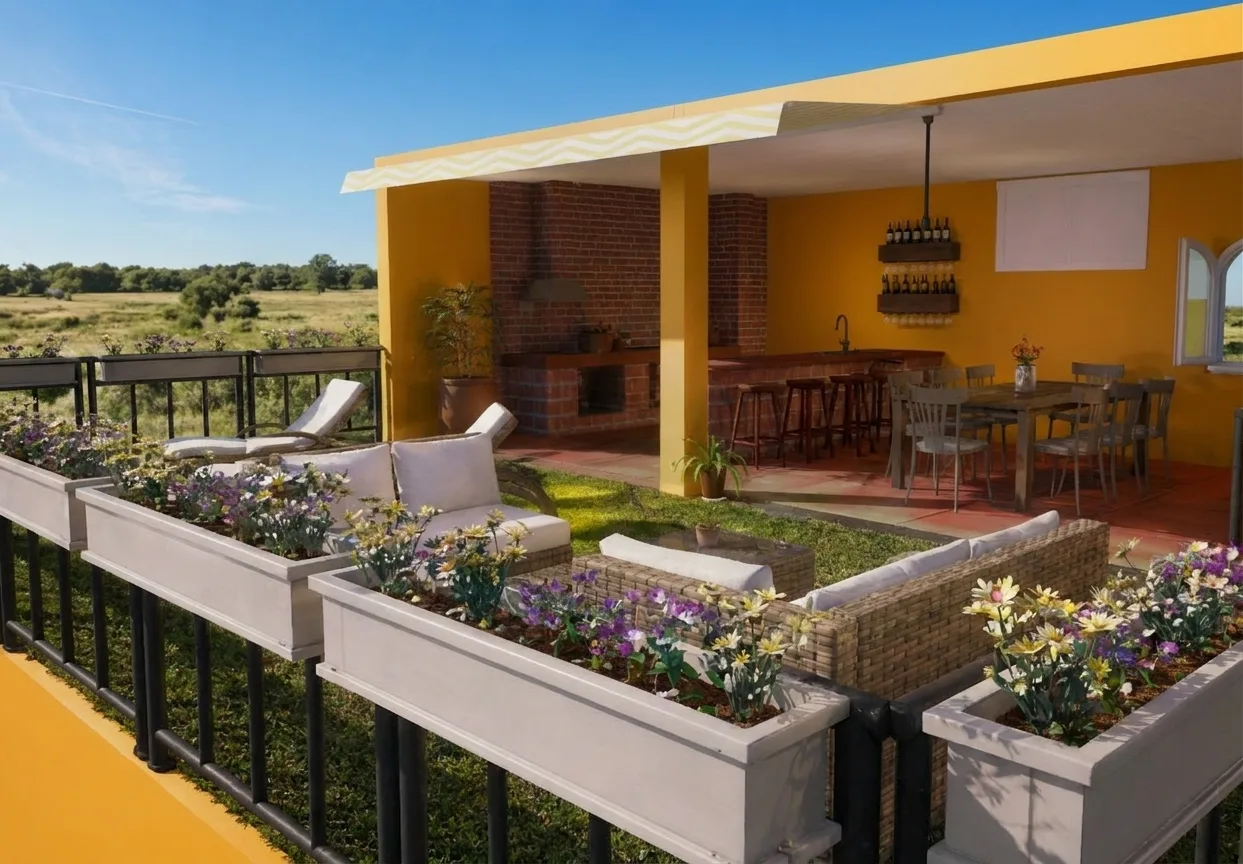
Coastal houses tend to start with the same sentence: the house is beautiful, but something keeps going wrong. A drawer that no longer closes in February. Rust weeping from a screw head. A leather armchair with a grey bloom across the seat after one closed winter. None of it is bad luck. It is a set of ordinary furniture decisions made with Northern European assumptions, in a place that punishes them.
The Portuguese coast is a wonderful place to own a home and a demanding one to furnish. This is the field guide we use ourselves: which metals last, which woods move, which finishes let a wall breathe, and what to do on the day you lock the house and fly home.
Why the Atlantic coast is harder on interiors than the Mediterranean
Four forces act on your interior at once, and they are not the ones people expect.
- Airborne salt. Chloride ions attack the passive layer that protects stainless steel and aluminium, so corrosion begins as small local pits rather than an even film.
- Winter humidity. Portugal’s national monthly averages run from around 85% relative humidity in January to about 56% in August. Coastal houses are rarely heated continuously, so walls stay cold and moisture condenses on the coldest surface in the room.
- Sun. Lisbon records roughly 2,875 hours of sunshine a year, and organic dyes photodegrade far faster than mineral pigments, which is why one end of a sofa fades first.
- The nortada. The north-westerly nortada blows from June to September, strongest in the afternoons, carrying fine sand through every window you love having open.
Two consequences follow. Mildew needs only 62–93% relative humidity and something organic to eat (leather, paper, cotton, wood) which describes the contents of a closed holiday home. And sheltered surfaces age worse than exposed ones: under a covered terrace, in a window reveal, behind a balcony railing, salt concentrates because rain never rinses it away.
Metals: what patinas, and what simply rusts
Metal is where a coastal specification differs most from a normal one, and the cheapest thing to get right at ordering stage.
- Stainless steel: grade 316 (EU 1.4401) rather than the common 304 anywhere near an open window, a bathroom or the outside. The molybdenum in 316 is what resists chloride pitting.
- Brass: solid brass patinates instead of rusting. For taps and bathroom fittings in sea air, ask for DZR (dezincification-resistant) brass, because chlorides can leach the zinc out and leave a porous copper skeleton. Lacquered brass fails wherever it is scratched; unlacquered and waxed is easier to live with.
- Aluminium: anodised or powder-coated for terrace and window-side furniture, never bare.
- Chrome plating pits quickly; matt stainless, bronze and ceramic finishes age better.
One rule underneath all of them: never mix metal families in a fixing. A plain steel screw in a brass hinge, with salty moisture between them, becomes a small battery and the weaker metal loses. And design a fresh-water tap into every terrace, anything you can rinse lasts far longer.
Wood: solid, veneer and MDF through the humidity cycle
Wood follows the room. A swing from roughly 85% humidity in winter to the mid-fifties in August means doors, drawer fronts and table tops move every year. Solid timber moves predictably and can be sanded and refinished; veneer is a thin layer over a core, and veneer repairs are difficult and sometimes impossible. Standard MDF is the real problem, it swells and warps in humid rooms whenever it is left unsealed, and a cut edge inside a cabinet is where it starts.
What we write into a coastal joinery spec
- Moisture-resistant (green) MDF or marine plywood for carcasses and any built-in near a bathroom, kitchen or exterior wall, with all faces and edges sealed, including the ones nobody sees. That is a line in the specification, not an upgrade to be negotiated away.
- Oak, walnut and ash indoors, finished with hardwax oil rather than thick lacquer. Oil can be repaired in place; lacquer traps moisture along joint lines and lifts.
- Outdoors: certified plantation teak, Accoya or thermally modified timber, left to weather to silver-grey rather than sealed with a film that will peel.
- Keep wardrobes and headboards a hand’s width off north- and west-facing exterior walls so air can move behind them, the cheapest anti-mould measure in the house.
Walls and floors: breathable finishes, cork and porcelain
Old Portuguese masonry was built to let moisture pass through and evaporate. Lime plaster and mineral paints (silicate or lime-based) keep that behaviour, and lime’s high pH discourages mould on the surface. Vinyl paints and cement skim coats do the opposite: they hold water inside the wall, then blister. Wallpaper deserves the same warning: paper and paste on a cold exterior wall are mildew food, so keep it to interior partitions.
On the floor, porcelain tile is the coastal workhorse, water absorption below 0.5% makes it effectively closed to moisture. Terracotta is charming and porous, and needs sealing and re-sealing. Azulejos have been the salt-proof answer for kitchen and bathroom walls on Portuguese buildings since the 16th century. Cork (Portugal’s montado produces roughly half the world’s supply) is impermeable, naturally fire-retardant and warm underfoot, which matters in a house that is cold on the day you arrive. For rugs, flat-weave wool or jute over tile, never foam-backed synthetics that hold damp against the floor.
Textiles, mattresses and the leather problem
Fabric is where a coastal house is won or lost, because the wrong choice does not just wear out, it smells.
- Linen dries faster than cotton, gains strength when wet and is not a keratin fibre, so mildew has little interest in it.
- Wool absorbs almost a third of its weight in moisture without feeling damp, and chars rather than melting.
- Leather and suede are the classic casualty: one closed winter and there is a bloom of mould across the seat.
- Solution-dyed acrylics for anything in direct sun or on the terrace, the colour is in the fibre, not on it.
- Loose covers that go in a washing machine are the practical luxury of a coastal house. Specify them at order stage; retro-fitting is expensive.
Mattresses need slatted bases and breathable covers; strip the beds and store bedding in sealed boxes when you leave. Linen or polyester voile filters ultraviolet without taking the view.
| Element | Specify | Avoid |
|---|---|---|
| Hardware & taps | 316 stainless, solid or DZR brass, bronze | Plain steel, thin chrome, mixed-metal fixings |
| Built-in joinery | Moisture-resistant MDF or marine ply, all edges sealed | Unsealed standard MDF, thin veneer |
| Wall finish | Lime plaster, silicate or lime paint | Vinyl paint, cement skim, wallpaper on exterior walls |
| Floors | Porcelain tile, cork, oiled hardwood | Unsealed terracotta, foam-backed carpet |
| Upholstery | Linen, wool, solution-dyed acrylic, washable covers | Leather, suede, cotton velvet |
| Terrace | Teak or thermally modified timber, powder-coated aluminium | Untreated softwood, plain steel frames |
Fix the building before you buy the sofa
No material choice compensates for a wall that is wet. Persistent dampness and mould are a health question as much as a decorating one: the WHO guidelines on dampness and mould (2009) link them to respiratory symptoms, allergy and asthma. Rising damp, failed render and blocked ventilation come first.
Then set a target: 40–60% relative humidity. Refrigerant dehumidifiers struggle in cold rooms; desiccant units suit high humidity at low temperatures, which is precisely the unheated Portuguese winter. Run one on a continuous-drain hose to a bathroom outlet and it works unattended for months. Add humidity-sensing extractor fans, trickle ventilation in the windows, and the habit of cross-ventilating on dry afternoons.
The lock-up-and-leave checklist
- Strip the beds; open wardrobe and drawer doors; stand cushions on edge; leave interior doors open.
- Pull heavy furniture a hand’s width off exterior walls.
- Set the dehumidifier to continuous drain.
- Close shutters against ultraviolet, but leave background ventilation open.
- Rinse terrace furniture and railings with fresh water; breathable covers, never plastic; cushions indoors in a dry box.
- Ask a local key-holder for a monthly airing visit and a photo.
- Keep a written inventory of finishes (paint codes, tile references, hardware suppliers) so repairs can be ordered remotely.
A house for you, your guests and possibly a rental
Most coastal homes lead two lives, and the design question is how to serve both without the interior turning into a waiting room. Give yourself one lockable owner’s cupboard for personal things, and make everything else guest-proof: washable covers, nothing fragile at child height, a real dining table for six to eight, blackout in the bedrooms, and a drop-zone at the entrance for sand, boards and wetsuits.
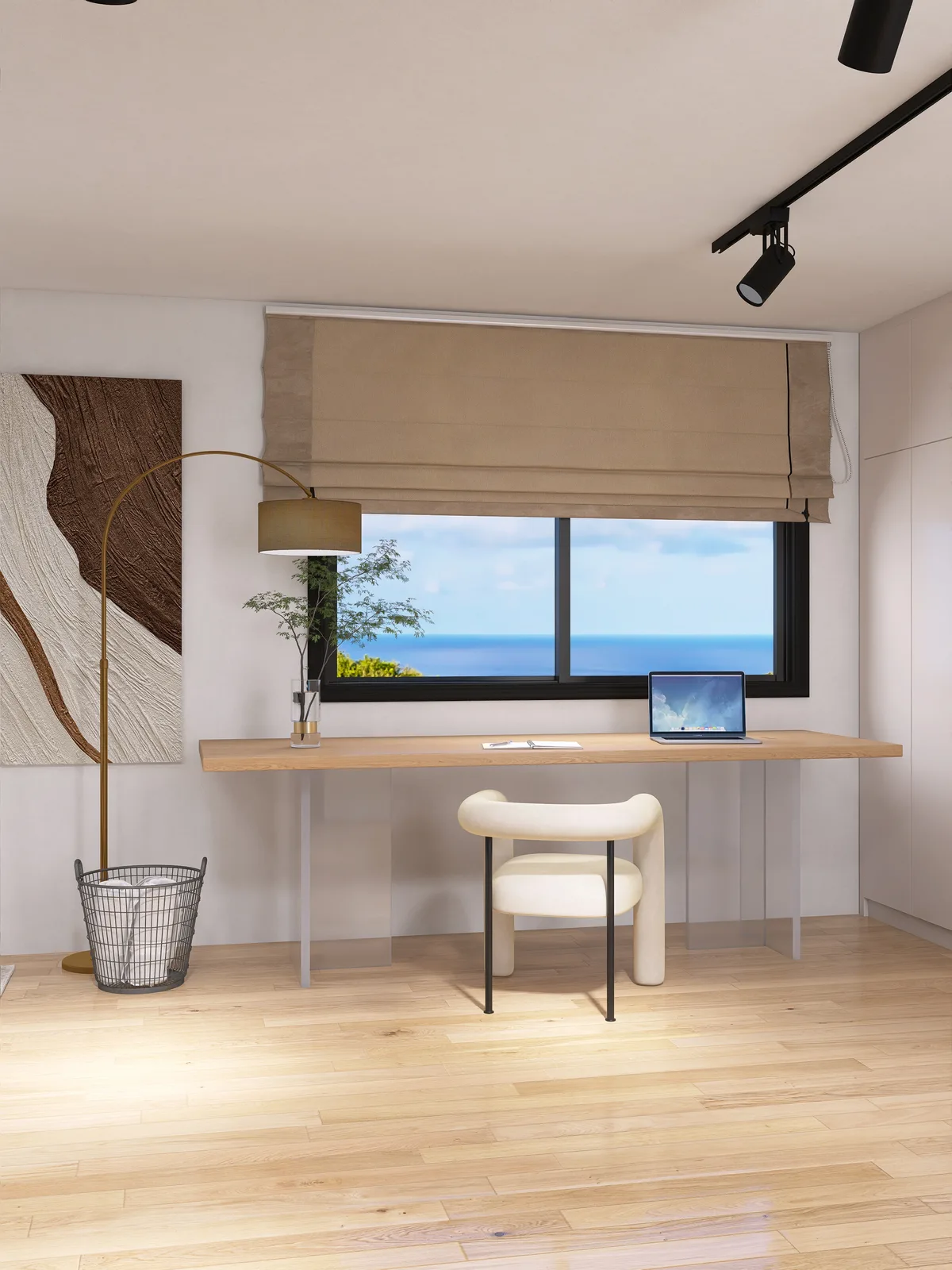
A sea-view workspace is one of the additions people ask about most often when a holiday home has to double as a remote-work base. Our Romina & CW project, a bedroom and workspace with a wall of white handleless wardrobes, a floating oak desk at the sea-view windows, sheer curtains and brass accents, shows the principle: storage and desk share one wall, so the view stays uninterrupted. If you intend to let the house as alojamento local, it is a registered activity with registration and safety obligations; check the current rules with your câmara municipal and your condomínio before you design around that plan.
Getting it built while you live somewhere else
Most coastal homes are planned by someone who is not there for most of the build, and our process is built for that: concept over video, on-site phases for measuring, site supervision and the final styling day, photo and video updates in between, and trades and suppliers coordinated directly, in Portuguese, English or German.
Sequence the long-lead items (custom joinery and stone) so the house never stands with an open wall through a winter, and plan for receiving: a key-holder, a dry storage room, and a check for transit damage before signing.
If your house is on the Silver Coast or the Ria, our pages for interior design in Figueira da Foz and interior design in Aveiro set out how we run projects there, from our Lisbon studio. Depending on how much you want handed over, that is full-service interior design, a focused interior design consultation, or online e-design if you would rather order and install yourself.
Frequently asked questions
Which metals survive salt air in a coastal home?
316 stainless steel, solid or dezincification-resistant brass, bronze, and anodised or powder-coated aluminium. Avoid plain steel, thin chrome plating and mixed-metal fixings, which corrode galvanically where salty moisture sits between them.
Is solid wood or veneer better for a house by the sea?
Solid wood moves with humidity but can be sanded and refinished. Veneer over standard MDF swells and delaminates, and veneer repairs are difficult and sometimes impossible. If you want veneer, specify moisture-resistant MDF or marine plywood with every edge sealed.
What humidity should a holiday home in Portugal be kept at?
Aim for 40 to 60 per cent relative humidity. Mildew becomes likely above roughly 62 per cent, and a desiccant dehumidifier on continuous drain keeps an unheated house in range through an Atlantic winter.
Which fabrics resist mould and fading?
Linen, wool and solution-dyed acrylics. Linen dries fast and is not a keratin fibre, so it resists mildew; wool absorbs about a third of its weight in moisture without feeling damp. Leather, suede, cotton velvet and paper wallpaper are the usual casualties of a closed winter.
Can a designer furnish my coastal home while I am abroad?
Yes. At Daradiant the concept phase runs over video; we travel for measuring, site supervision and the final styling day, coordinate trades and suppliers, and send photo and video updates between site visits.
Does a rental-ready interior have to look like a hotel?
No. Washable natural textiles, a lockable owner’s cupboard, blackout in the bedrooms and a sand-proof entrance make a house guest-ready while it keeps its character. If you plan to let it as alojamento local, check the registration and safety obligations with your câmara municipal and condomínio first.
Where to start
Buy a hygrometer and leave it in the coldest room for a week. That one number tells you whether the house needs building work, a materials rethink, or a better routine.
When you are ready for the plan itself, send us the house (photos, floor plan, how many weeks a year you are there) through the project request form, and you will have a free, phased proposal within 24 hours. If you would rather talk it through first, a €99 1:1 Design Call is an hour with Dania and your materials list.