
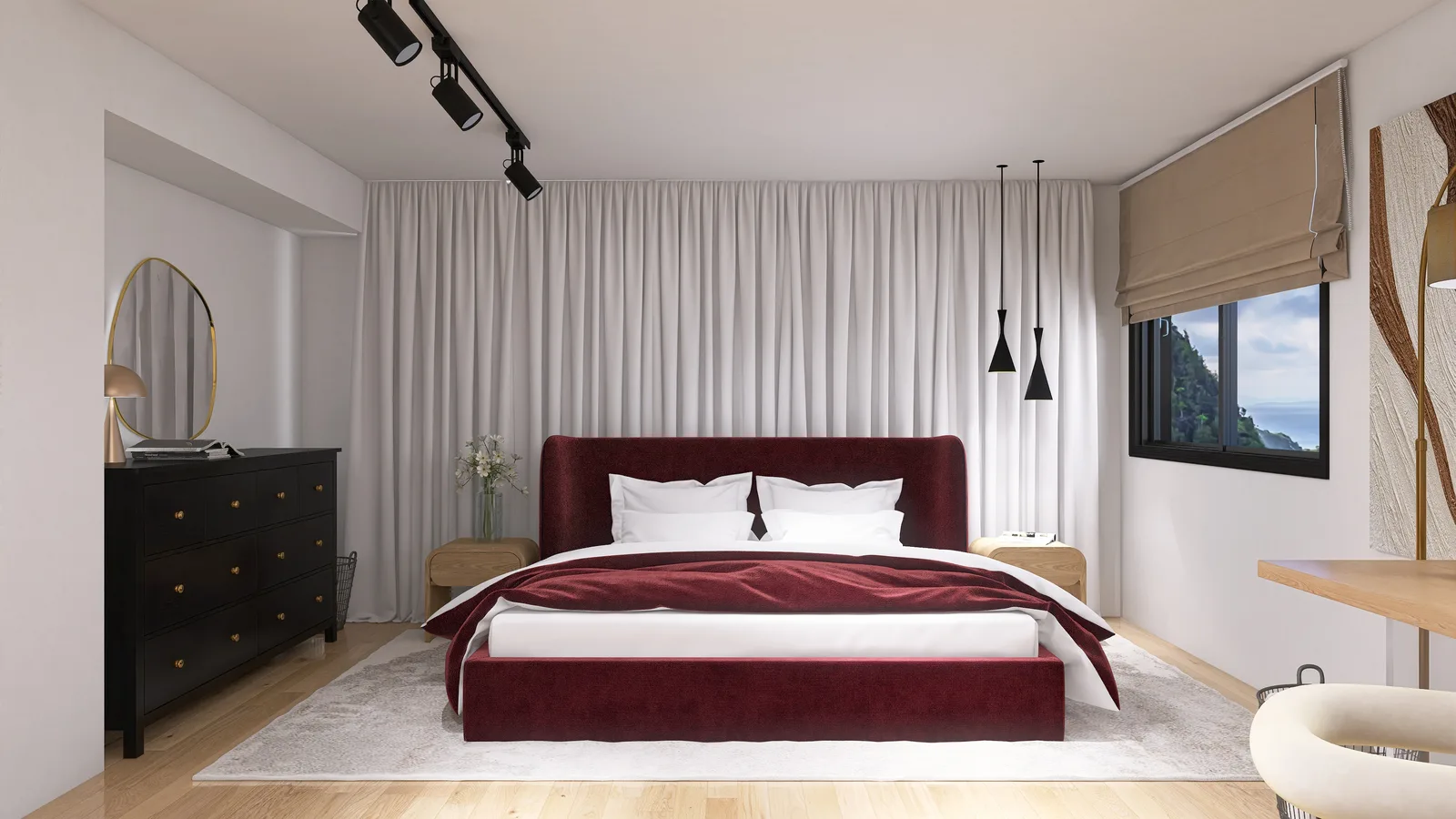
It is the first question almost every new arrival asks after collecting the keys to a flat in Oberkassel or a new-build in Le Flair: there is no kitchen, no lights, just wires out of the ceiling, is this normal? It is. A German unfurnished apartment is emptier than almost anywhere else in Europe, and the six to eight weeks after you sign decide whether you eat takeaway off a packing box until winter or sit down to dinner at home.
Here is what you have actually rented, the order in which to decide, what the tenancy rules allow, and how a furnishing project in Düsseldorf or Neuss is run in English from our Lisbon studio.
What “unfurnished” really means in Germany
An unfurnished German flat arrives without a fitted kitchen, ceiling lights, curtains or a washing machine. If a listing includes a kitchen it says so: EBK (Einbauküche); if not, expect a bare room with a water connection.
The reason is legal rather than cultural: a tenant who installs something may take it out again when they leave (§ 539 BGB). Kitchens are treated like furniture (they belong to the person, not the building) as are lamps and wardrobes.
What you find behind the door depends on the building. The quarters built on former rail and industrial land (Le Flair in Derendorf, Grafental in Flingern-Nord, Heinrich-Heine-Gärten in Heerdt, Belsenpark in Oberkassel) are handed over as white shells; a 1950s flat in Bilk may come with a dated kitchen the outgoing tenant wants to sell you; an Altbau in Golzheim gives you three-metre ceilings, stucco and a kitchen-shaped void. And the Berlin rule obliging landlords to supply a stove and sink on request does not apply in North Rhine-Westphalia.
The numbers on the lease
- Kaltmiete is the cold rent; Warmmiete adds the advance for heating and building costs. Electricity and internet are your own contracts.
- The deposit (Kaution) is capped at three times the cold rent, payable in three monthly instalments (§ 551 BGB).
- Asking rents averaged around €13 per square metre city-wide in mid-2026, and €13–17 in sought-after locations (asking rents, immobilienscout24), a layout here has to earn every square metre.
Your first fortnight: paperwork that shapes the plan
Five things happen before you buy a screw, and each changes what you order.
- Register your address with the Meldebehörde within two weeks of moving in (§ 17 BMG). The Expat Service Desk ME & DUS, run by the city, Kreis Mettmann and the IHK, walks international specialists through it.
- Insist on a written handover protocol (Übergabeprotokoll) and photograph every wall, floor and socket: what is not recorded at move-in cannot be charged at move-out.
- Read the lease for the Schönheitsreparaturen clause. Shifting repainting to you is invalid if the flat was handed over unrenovated without compensation (BGH, VIII ZR 185/14).
- Measure on day one: ceiling heights, door widths, the turn of the staircase, radiator and socket positions, in an Altbau, most delivery failures are staircase failures.
- Ask about an Ablöse, buying the outgoing tenant’s kitchen or wardrobes. Legal, and it saves weeks, but a price wildly out of proportion to what the pieces are actually worth is unenforceable (§ 4a WoVermittG).
The order of decisions when you have six to eight weeks
The most expensive mistake is choosing the sofa first. The kitchen has the longest lead time in the flat, so everything is sequenced backwards from the fitter’s date: German retailers quote roughly four to eight weeks for a standard fitted kitchen and up to sixteen for a custom one, with appliances from in stock to months away. Ordering it before you land is the largest time saving available.
| Week | Decision | Why it goes here |
|---|---|---|
| 0–1 | Measure, handover protocol, lease check, budget frame | Everything downstream depends on it |
| 1 | Kitchen ordered, or Ablöse agreed | Longest lead time; it fixes the move-in date |
| 1–2 | Lighting plan and electrician | Before furniture blocks the walls |
| 2–3 | Storage and beds ordered | What makes the flat liveable on night one |
| 3–4 | Loose furniture with real lead times | Can take as long as a kitchen |
| 5–6 | Kitchen fitted, deliveries land, assembly | Trades sequenced so nobody blocks anybody |
| 7–8 | Rugs, curtains, art, styling day | The layer you see, done in one pass |
On a full-service project this becomes a dated procurement list, and we coordinate trades in German so the electrician, the fitter and the wardrobe delivery arrive in the right order, not on the same morning.
Budget logic, with quality tiers
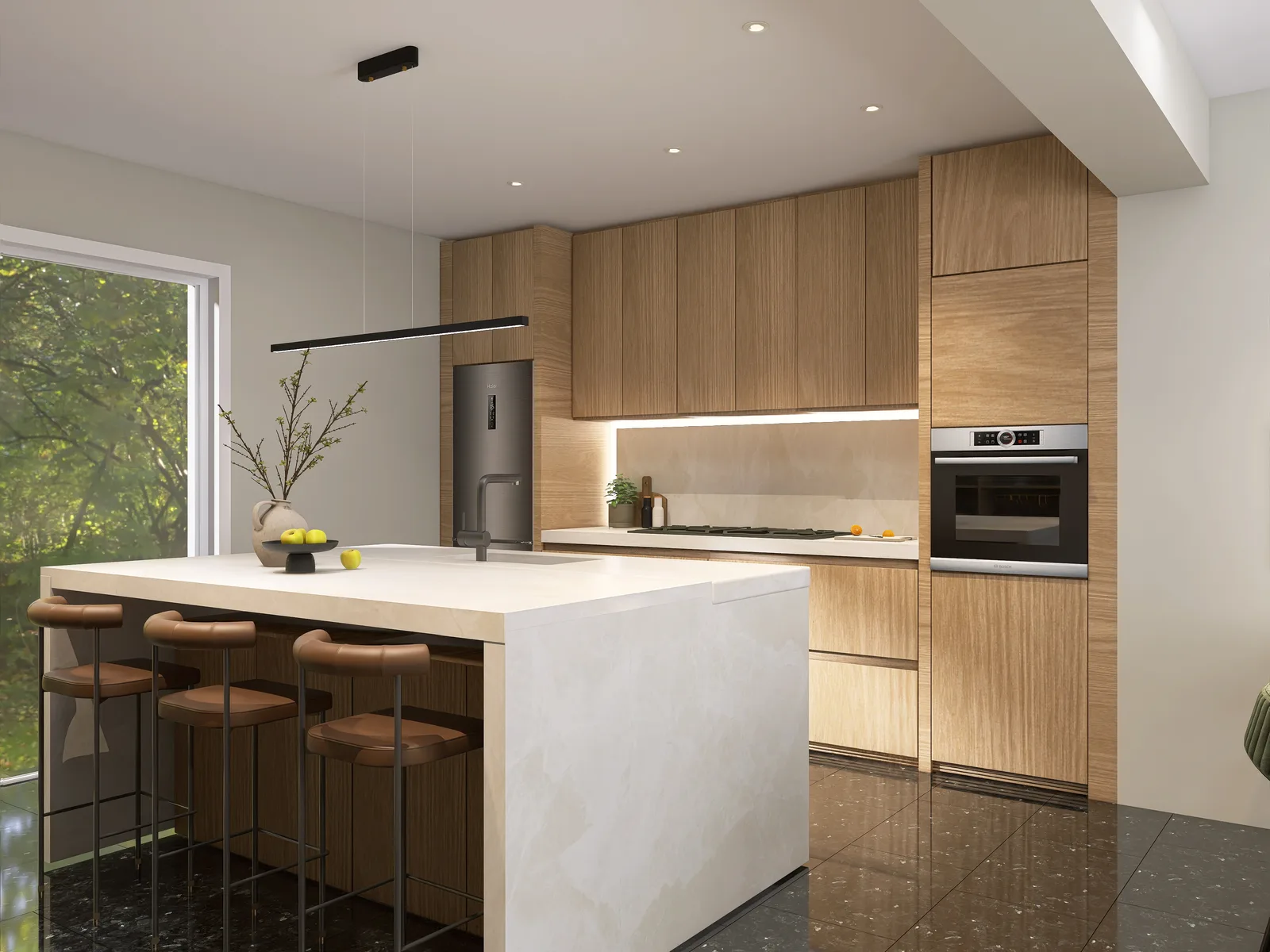
We do not publish prices (every project gets a free, transparent proposal within 24 hours) but you need a frame before the first showroom, so here are third-party benchmarks. The cost portal kostencheck.de puts a basic set-up for two in a 45 m² flat at under about €1,500, and a high-end flat of the same size at €25,000 and more: the same rooms, ten to twenty times apart. Kitchens follow that spread, simple single runs from roughly €900 to €3,000, island kitchens from about €6,000, designer kitchens well above €10,000.
- Spend where your body is: mattress, sofa, dining chairs, the light you read by. Save on side tables, décor and the second guest bed.
- Budget the invisible lines: electrician, assembly, delivery to a fourth floor without a lift, curtains made to measure for three-metre windows.
- Sort every item into three columns before you shop, buy well and keep, buy simply for this posting, rent.
Oberkassel Altbau, Le Flair or a Neuss terraced house: what fits where
Düsseldorf’s housing stock follows its history: roughly 92,000 of the city’s 176,000 flats were destroyed in the Second World War, so 1950s buildings dominate Stadtmitte, Bilk and Derendorf, while pre-war Altbau survives in Oberkassel, Golzheim, Pempelfort and Benrath.
Gründerzeit Altbau: Oberkassel, Golzheim, Pempelfort
Ceilings over three metres, stucco, long corridors, rooms opening into one another. Go tall with wardrobes and low and wide with sofas, hang pendants on long drops, give each room its own rug, and turn the corridor into a library wall. Orientation differs between the two riverside quarters: in Oberkassel the Rhine lies to the east, so river-facing rooms get the morning and it is the west-facing rooms, away from the water, that take the hard late-afternoon light. In Golzheim it is the other way round, the Rhine is to the west, and the river side carries the summer evening sun. Either way sheer curtains handle it better than heavy ones, and furniture belongs slightly off uninsulated walls behind old box windows (Kastenfenster).
1950s post-war flats: Stadtmitte, Bilk, Derendorf
Small rooms, thin walls, less daylight: fewer and slimmer pieces, handleless wall-to-wall storage like the wardrobe wall in our Romina & CW project, wall lights instead of floor lamps, and textiles for the acoustics you would otherwise share.
New-build shells: Le Flair, Grafental, Belsenpark
Large glazing, underfloor heating, a white box: the kitchen and the lighting are the design, and after that the job is warmth, oak, walnut, wool, bouclé, terracotta, brass. Düsseldorf records about 1,527 hours of sunshine a year against Lisbon’s roughly 2,875, so layered, dimmable light at 2700–3000 K matters far more here than in Portugal.
A family house in Neuss
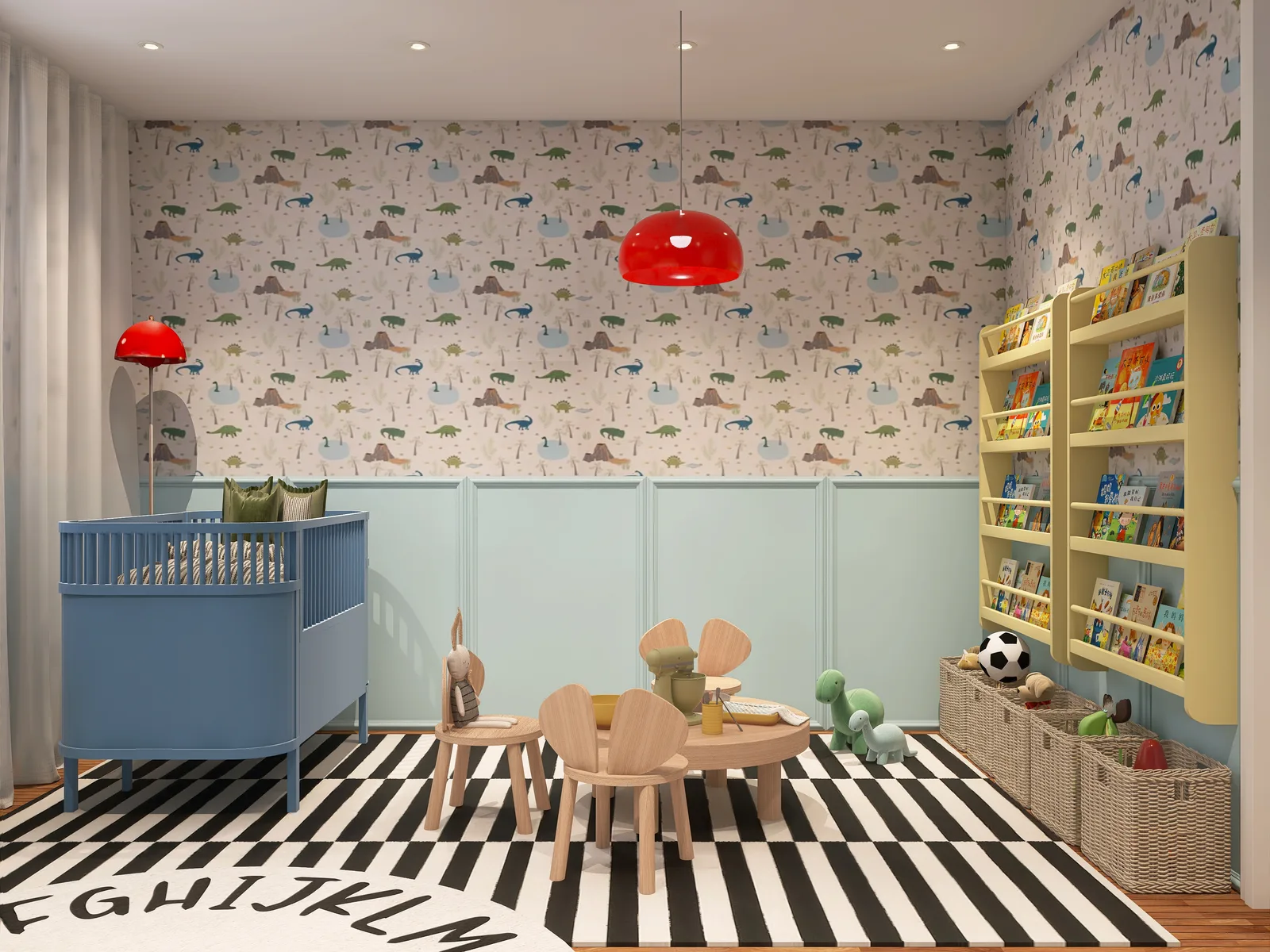
Families who commute into Düsseldorf by tram 709 or S-Bahn from a terraced house or semi in Norf, Rosellen or Allerheiligen face a different brief: an entry zone that swallows boots, prams and school bags, a kitchen-dining room as the centre of family life, children’s rooms planned to grow, as in The JJ Project in Heinsberg. The rest is on our interior design in Neuss page.
Rental-friendly choices you will not regret when you move out
What stops many internationals from making a rented flat feel like home is the deposit, yet the rules are more generous than the fear suggests. General information, not legal advice: check your lease, or join the local Mieterverein.
- Drill holes are fine. Wear from normal contractual use is not your liability (§ 538 BGB), and a reasonable number of screw holes counts as exactly that; without wear marks you generally need not repaint (BGH, VIII ZR 166/08).
- Colour is yours while you live there. A landlord cannot dictate colours during the tenancy (BGH, VIII ZR 224/07), but a tenant who handed back strong-coloured walls owed damages (BGH, VIII ZR 416/12). Paint boldly, repaint before you leave.
- Keep your kitchen removable. Freestanding or modular kitchens preserve your removal right; a landlord who wants one to stay can only prevent removal by paying reasonable compensation (§ 552 BGB).
- Prefer reversible upgrades: plug-in pendants, tall shelving instead of built-ins, rugs over tired floors, curtain tracks on clamp fittings.
- Anything permanent needs written consent, built-in wardrobes, new floors, new walls. And plan the exit at the start: notice given by the third working day of a month ends the tenancy two months later, roughly three months in practice (§ 573c BGB), and the deposit usually returns only after the final service-charge statement.
Renting or buying for a two- or three-year posting
If your contract says three years and your relocation package says forty cubic metres, buying everything twice makes no sense. Furniture rental exists in Germany: In-Lease, for instance, rents from one to twelve weeks or four to sixty months with delivery and assembly, and Wunderflats lists furnished flats as a bridge before the unfurnished lease starts. We have no commercial relationship with either, they are simply options that exist.
The hybrid that usually works: rent the bulky and generic, buy the personal (bed, textiles, art, the children’s furniture) and keep the kitchen as its own decision. Kitchens and wardrobes are what the next tenant pays an Ablöse for.
How we furnish a Düsseldorf apartment from Lisbon
An honest word about the set-up. Daradiant is based in Lisbon and works in North Rhine-Westphalia; Dania Lima works in English, German and Portuguese. The concept phase (layout, lighting plan, materials, furniture, procurement list) runs over video in English with you, while electricians, kitchen fitters, joiners and deliveries are coordinated in German. There is no Daradiant office in Düsseldorf.
The on-site phases (measuring, site supervision at the milestones and the final styling day) are bundled into planned trips to Düsseldorf or Neuss, with photo and video updates in between so you watch the kitchen go in from your desk. Where standard sizes fail, we commission custom joinery.
There are two ways in: full-service interior design covers the whole apartment from measuring to styling day, while online interior design gives you the plan, the sourcing list and the sequence to execute yourself. Read how we work as an English-speaking interior designer in Düsseldorf, or what an interior design consultation covers if you need a second opinion only.
Frequently asked questions
Why do apartments in Germany come without kitchens?
Because tenants own their kitchens: by law a tenant may remove fixtures they installed themselves (§ 539 BGB), so kitchens travel with people. An unfurnished flat therefore has no kitchen, no ceiling lights and no curtains; listings that include one say EBK.
How long does it take to furnish an unfurnished apartment in Düsseldorf?
Plan six to eight weeks if the kitchen is ordered immediately: retailers quote roughly four to eight weeks for a standard fitted kitchen and up to sixteen for a custom one, and upholstery is similar. Lighting, storage and beds come next; styling last.
How much does it cost to furnish an apartment in Germany?
Third-party benchmarks from kostencheck.de run from under about €1,500 for a basic two-person set-up in 45 m² to €25,000 and more for a high-end flat of the same size; kitchens alone go from roughly €900 to well above €10,000. Daradiant quotes each project individually, free, within 24 hours; the only fixed price is the €99 Design Call.
Should I buy the previous tenant’s kitchen (Ablöse)?
Often yes, because it saves weeks of lead time. The price must reflect the kitchen’s actual value (a price wildly out of proportion to what the kitchen is actually worth is unenforceable under § 4a WoVermittG) so ask for the original invoice and age, and have the layout checked first.
Do you work in English, and do you have an office in Düsseldorf?
We work in English, German and Portuguese. The studio is in Lisbon and has no office in Düsseldorf: concept and sourcing run over video, while measuring, site supervision at the milestones and the styling day are bundled into planned trips, trades coordinated in German. The JJ Project in Heinsberg is our completed NRW reference.
Where to start this week
Measure, photograph, read the lease, then order the kitchen, before the sofa. If you would rather hand the sequence to someone who has run it before, tell us about your flat: we reply within 24 hours with a free proposal. Or book a Design Call and bring your floor plan.