
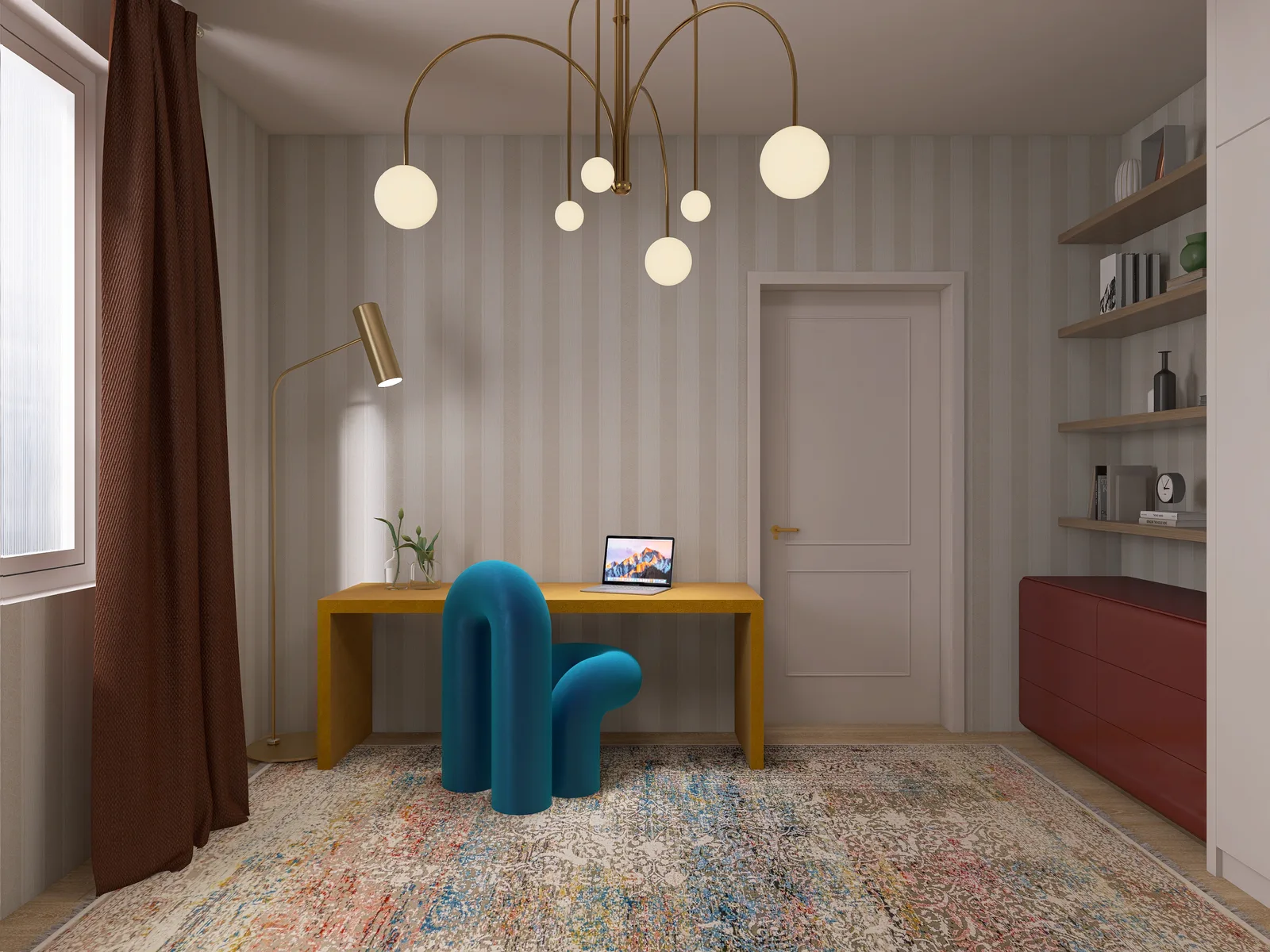
The flat is in Aveiro and you are in Zurich; the next time you can stand in that living room is four months away. Or the house is near Aachen, the keys arrive in six weeks, and the one thing you know is that the sofa you own will not fit. Online interior design exists for exactly these situations: the full design process, run without you and your designer ever standing in the same room.
What follows is the whole sequence, what you prepare, what lands in your inbox, and the moment a screen stops being enough.
Who online interior design is for, and when you still need someone on site
E-design is at its best when the walls stay where they are: a newly bought T2 in Portugal, a rented flat in North Rhine-Westphalia, a holiday home you would like to feel finished rather than camped in. It suits people who could not host a site visit anyway, relocators planning before the move, emigrant families preparing a house they will return to, owners who bought at a distance with one afternoon of photos to work from.
Where it stops is equally clear:
- Structural work, moving or removing walls, altering openings, anything that needs an engineer.
- Kitchens and bathrooms with new services, once plumbing or electrics move, the room needs a proper survey.
- Façades, windows and shared parts of a building, in Portugal, works that change the architectural line or the aesthetic arrangement of a building need the authorisation of the assembleia de condóminos under article 1422.º of the Código Civil. Confirm licensing questions with your câmara municipal.
For homes in Portugal and in North Rhine-Westphalia, that is where our on-site phases take over, measuring, site supervision and a final styling day, with full-service interior design around them. Elsewhere, your plan travels to a local contractor and we stay on the other end of the line.
Two things follow from that. E-design is not a discounted version of design, it is the same thinking, delivered digitally. And a studio is not a marketplace: instead of a designer assigned by algorithm, the same person runs your project from the first question to the last cushion.
Step 0: the €99 design call, the low-risk way to start
Few projects begin as projects. They begin as a question that is hard to answer alone: keep the wall or open it, restyle or renovate, buy the flat or keep looking. That is what the 1:1 Design Call is for, sixty minutes on Google Meet with me, booked and paid online, and deliberately the smallest possible commitment.
Bring: a floor plan or sketch, phone photos, the problem that bothers you most, and a budget band you can say out loud.
Leave with: straight answers on layout and priorities, a recommendation on which route fits, online design, an interior design consultation or full service, and, if you continue, a free proposal within 24 hours. It is not a sales call, you are free to take the advice and act on it yourself.
Step 1: your brief, questionnaire, photos and measurements
This stage decides whether remote design works, and it is the easiest one to rush. Our questionnaire asks about routines rather than styles, because a room is designed around behaviour: how many of you eat at the table on a Tuesday, who works from home and until what hour, how often guests stay.
Photograph the room the way a designer needs it
- Shoot in daylight with the lights off, we need the room’s real light, not a warm bulb’s version of it.
- Stand in each corner and photograph the opposite corner, then take one shot from the doorway, ceiling to floor.
- Include the unglamorous things: radiators, sockets, the boiler cupboard, the direction each door swings.
Measure less than you fear, but measure the right things
- Wall lengths, ceiling height, and the width of every door opening.
- Window sill and head heights; positions of radiators, sockets and any immovable service.
- Every piece you intend to keep: width × depth × height, photographed alongside.
A laser measure and a hand-drawn sketch are enough; precision matters more than neatness.
Two more things belong in the brief. A budget band, a range you can name, not a wish, because it decides whether the sofa is made to order or bought off the shelf. And your fixed dates: a completion date, a tenancy start, a baby due in March. Those dates drive sourcing, and sourcing drives everything else. For inspiration, five to ten images with one sentence each on what you like in them beat a board of two hundred pins.
Step 2: the video briefing
Next comes a scheduled video call, set to your timezone. Most of the process runs asynchronously by email; this hour is the exception, and it is where the brief becomes real.
You walk the room with your camera, the corners, the light at that hour, the awkward parts: the beam that cuts the ceiling, the window that will put a screen in glare all afternoon. Things invisible in photographs become obvious in thirty seconds of video.
By the end we have locked room priorities, the pieces that stay, the budget band, the hard dates, and whether local trades are needed at all. We also record orientation and window sizes, because light is not a constant across the two countries we work in: long-term normals put Lisbon at roughly 2,875 sunshine hours a year and Düsseldorf at around 1,527 (national meteorological normals, IPMA and DWD), and the same terracotta is a different colour in each. If the home is in Central Portugal, this is when we discuss whether a visit makes sense, see how we work as your interior designer in Aveiro or in Leiria.
Step 3: the concept, layout, mood and material palette
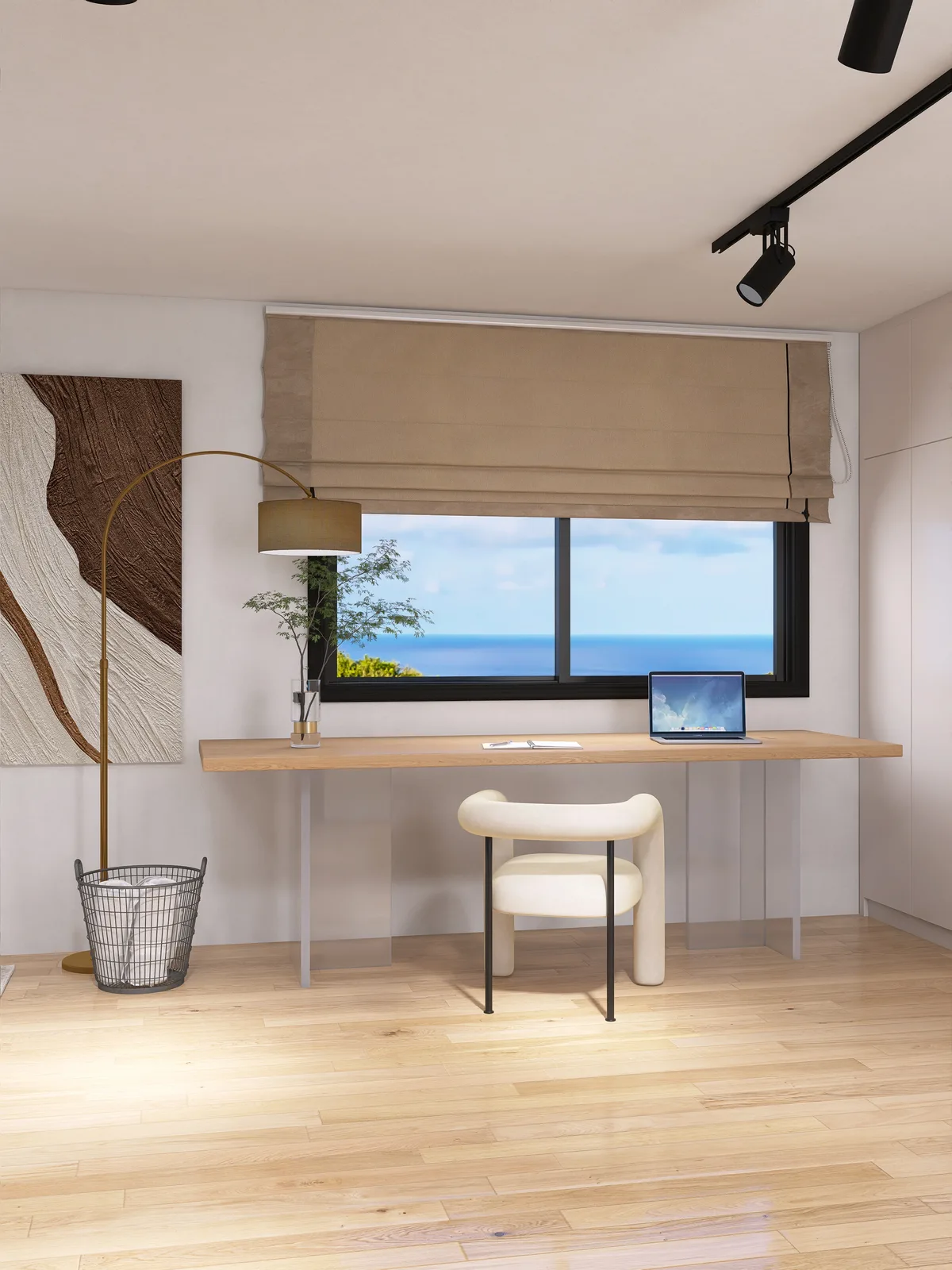
Every online interior design package includes a design concept with moodboards, a to-scale floor plan, a clickable shopping list and a styling guide. The concept arrives first, and layout comes before anything you can see: how you cross the room, where the bed faces, where the desk meets daylight, which wall absorbs the storage. In Romina & CW that meant a floating oak desk at the windows and a wall of white handleless wardrobes doing the invisible work, so the rest of the room could stay quiet.
The material palette is chosen for your climate and your light. Salt air near the Portuguese coast rules out some finishes and rewards others; darker northern winters change how much warmth a room needs from its textiles and wood tones. So the concept names things (this oak, this bouclé, this brass, this depth of green) rather than “warm neutrals”. And it is presented over video, so you hear the reasoning behind each decision.
Step 4: the revision round, how feedback is handled
One structured revision round is included in every package. It refines the concept rather than restarting it, and the difference lies in how the feedback is written.
Useful feedback is about function and feeling: the desk will be too dark by five; the chair feels formal and we are not formal people; we would rather spend more on the sofa and less on the rug. Less useful is a link to one different lamp, a lamp is a symptom, the concept is the system.
This is also where the budget is brought back into line: pieces move up or down within the band you named, and if the total does not work we change the plan. For context, the platform Decorilla advertises unlimited concept revisions but a single revision on its 3D renderings. A structured round is a deliberate choice in the other direction, decisions get made, and a project that keeps moving finishes.
Step 5, and the optional Step 6: what you receive
The package is built to be acted on by someone standing in the room alone.
| Stage | What you prepare | What you receive |
|---|---|---|
| Design call | Floor plan, photos, your main problem, a budget band | Straight answers, priorities, a recommended route |
| Brief | Questionnaire, daylight photos, measurements, fixed dates | A free, transparent, phased proposal within 24 hours |
| Briefing call | A slow camera walk through the room | Agreed priorities, confirmed constraints |
| Concept | Nothing, this one is ours | Moodboards, to-scale plan, materials, lighting positions |
| Revision | Honest feedback in one go | A refined concept and a budget that adds up |
| Delivery | Your ordering pace | Shopping list, styling guide, final plan |
The shopping list is clickable: every item linked, sized and priced, so you can order from anywhere as budget allows. The styling guide covers what people find hardest once the boxes arrive, how the shelf is dressed, where the rug edge sits, which bulb temperature keeps a room warm after dark. The to-scale plan goes to movers, an electrician or a carpenter; custom joinery can be drawn for a workshop near you.
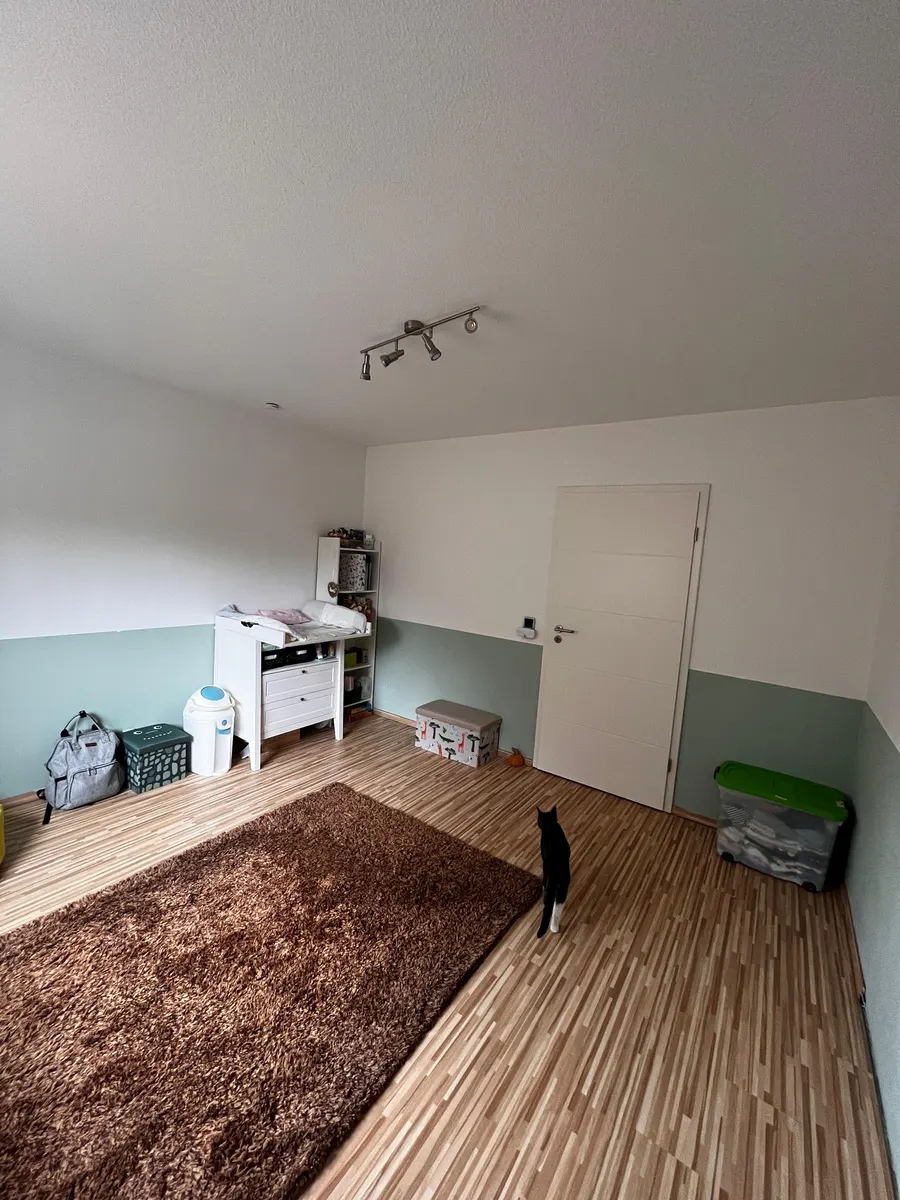
Step 6 is optional and geographic. For homes in Portugal and in NRW we add trades and supplier coordination in the local language, plus on-site phases (measuring, site supervision at the milestones, a styling day) planned as bundled visits, with photo and video updates in between. That is the model behind our work as an interior designer in Aachen. The JJ Project in Heinsberg shows what a nearly empty room can become once a full concept is carried all the way through.
How long online interior design takes, and why free or AI tools stop where the work starts
Here is the honest version. We reply to project requests within 24 hours with a free, transparent, phased proposal. After that, concept and revision timing depends on how many rooms are involved and how quickly you send feedback, which is why we do not print a “your design in 7 days” badge. For reference, Havenly says first concepts typically come back in three to fourteen days; Decorilla describes two concepts within a week and one to three weeks of refinement. A studio timeline is quoted per project.
Design time is rarely what holds a project up. Lead times are. A made-to-order sofa or a run of joinery can outlast every other stage, which is why the shopping list is sequenced: slow things first.
A word on the free alternatives, genuinely useful within their limits. Retailer planners (IKEA’s free planning service, for instance) will plan a kitchen or a wardrobe well, and they plan that retailer’s catalogue. AI room generators produce a persuasive image in seconds, and an image is not a plan: no measurements, no budget, no supplier, no answer when the sofa in the picture does not exist here. What you pay a designer for is none of the pretty parts. It is the decisions: circulation, proportion, light, what to keep, and where to spend the money you have.
Frequently asked questions
How does online interior design work in practice?
You book a €99 design call, then complete a questionnaire and send photos and simple measurements. After a video briefing, Dania Lima (the same designer throughout) designs your room remotely: a concept with moodboards, a to-scale floor plan, a clickable shopping list and a styling guide, refined in one included revision round.
What do I need to prepare before the first call?
A floor plan or sketch, daylight photos from each corner, rough measurements (walls, ceiling height, windows, doors), a list of pieces you keep, a budget band and any fixed dates. The design call is the place to bring doubts, not finished answers.
Can e-design work for a home in Portugal I have not moved into yet?
Yes, planning a home before you move into it is exactly the situation e-design is built for. Photos and measurements can come from an agent, a relative or a first visit; the shopping list lets you order before you arrive, and on-site phases can be added later.
How long does an online interior design project take?
We reply to project requests within 24 hours with a free, transparent proposal. Concept and revision timing depends on the number of rooms and how quickly you send feedback, and furniture lead times, not design time, usually set the final calendar.
What cannot be done online?
Structural changes, plumbing and electrical rework, and anything touching a façade or a building’s shared parts need on-site planning and often formal permission, in Portugal, the authorisation of the assembleia de condóminos under article 1422.º of the Código Civil. For homes in Portugal or NRW we add on-site phases; elsewhere your plan goes to a local contractor.
Is it the same designer throughout?
Yes. Daradiant is a studio, not a marketplace: Dania Lima runs the briefing, the concept, the revision and the styling guide, in English, German or Portuguese.
Where to start
If you already know the room and the problem, describe it on the project request form and you will have a free, transparent proposal within 24 hours. If you are still weighing online interior design against a designer in the room with you, start with the €99 Design Call, an hour spent before you spend anything else.